Business Model Breakdown
Postman Business Model Breakdown: How the World's Leading API Platform Makes Money
Postman is the world's leading API platform, used by 40M+ developers and 98% of the Fortune 500. This breakdown unpacks what it does, the job it gets done, and how its free-for-developers, monetize-the-enterprise model actually makes money — from our episode with Co-Founder & CEO Abhinav Asthana.
“I don't think anyone in their right mind decides to serve developers. When developers choose you, you decide to serve them.”

At a glance
- Founded
- 2014
- Revenue model
- Free for developers, paid for teams & enterprise
- Developers
- 40M+
- Enterprise reach
- 98% of the Fortune 500
Postman is an API platform that helps developers and enterprises design, test, manage, and distribute APIs — trusted by more than 40 million developers and 500,000 organizations, including 98% of the Fortune 500. This breakdown unpacks what Postman does, the job it gets done for customers, the mental model behind why it works, and how it actually makes money — drawn from our episode with Abhinav Asthana, Co-Founder & CEO of Postman.
What is Postman?
Postman started as a side project to solve one thorny problem: testing an API and seeing exactly what comes back over the wire, without wrestling clunky tooling. Founded in 2014, it grew into a full API platform — a system of record for how organizations design, build, and ship APIs — with AI now embedded into its core.
Postman powers the full API lifecycle:
- Designing and documenting APIs
- Testing and debugging API calls
- Automating and monitoring API workflows
- Cataloging, governance, and developer portals
- Distributing APIs (and SDKs) to internal and external consumers
In plain terms: wherever an API is built or consumed, Postman is the tool that makes it work.
The Product
The product is designed around the job-to-be-done — get an API working and trusted — rather than aggregating a pile of features. From the beginning, Abhinav built it with an obsessive design instinct: most API tools were "designed without intent," overwhelming new users with buttons. Postman was the tool he'd want to use every day.
Before Postman: developers stitched together network tracers and awkward utilities to inspect API responses, got stuck when an API wasn't ready or broke in unexpected ways, and had no shared way for a team to collaborate on API workflows.
With Postman: testing an API is a few clicks; teams share collections, environments, and workflows; and the same platform carries an API from design through production monitoring. The effort to get an API working and shared drops dramatically.
Free-and-Open as a Mental Model
Postman embodies the "free for the builder, paid for the buyer" model that defines durable developer platforms. You can't tell developers what to use — they choose the tools themselves — so the developer layer has to be genuinely free, open, and delightful. Monetization comes later, from the managers and enterprises who need to prove ROI, governance, and security.
Just as open-source databases and cloud SDKs won adoption by being free at the developer layer and monetizing scale and support above it, Postman gives individual developers a free, best-in-class tool and charges when that usage becomes a team- and enterprise-wide system of record.
Business Model
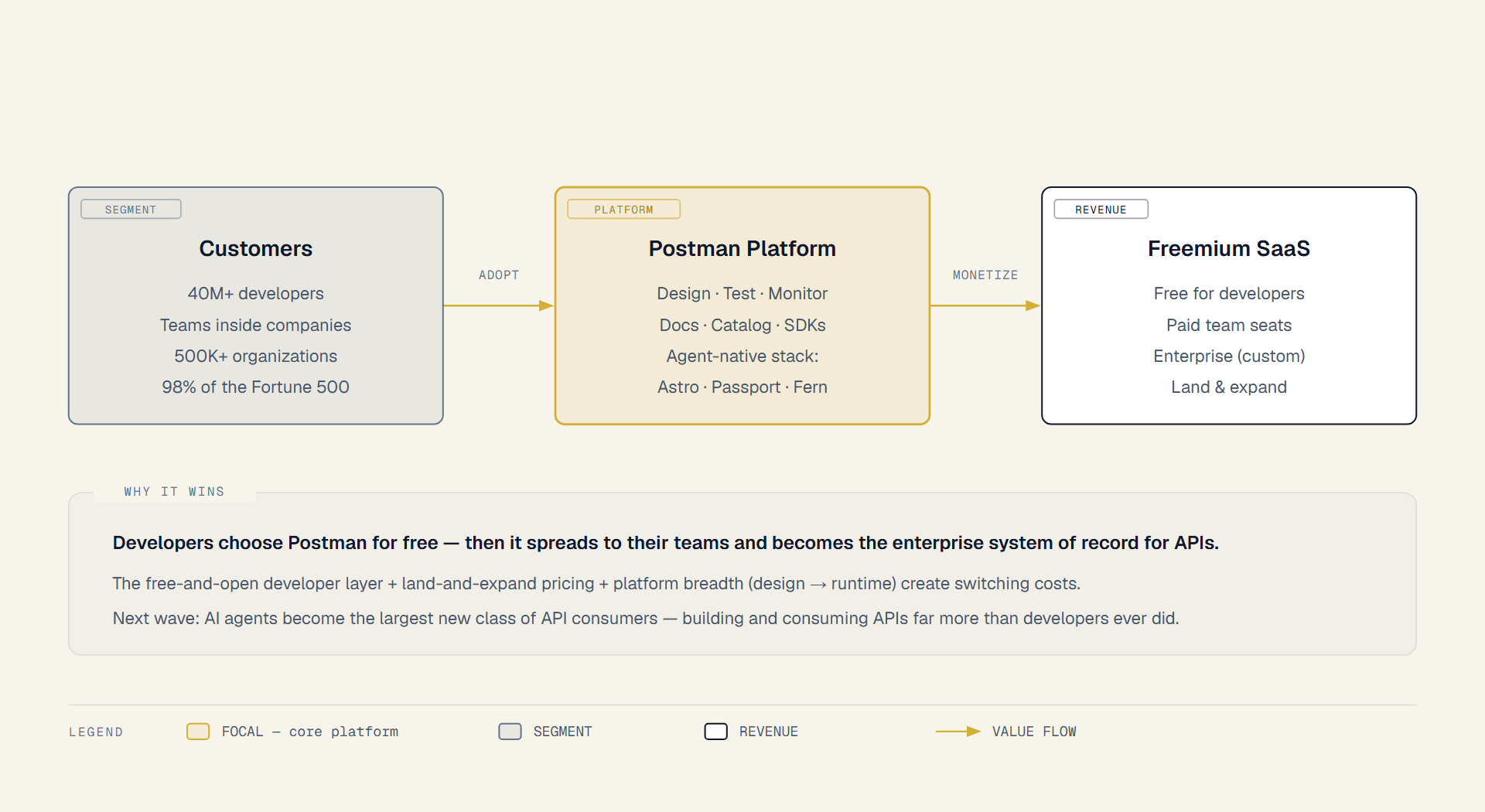
Postman makes money through a freemium, land-and-expand SaaS model. The strategy is deliberate: keep the individual developer experience free and open forever, then monetize collaboration, governance, security, and scale as usage spreads from one developer to a team to an enterprise. Postman first reached "Ramen profitability" not through venture funding but through simple in-product upgrade purchases — and the aha moment came when teams started buying those upgrades in bulk.
How they charge:
- Free — individual developers get the core tool free and open, forever
- Team / Professional — per-seat plans for teams collaborating on shared collections, environments, and workflows
- Enterprise — custom pricing adding governance, security, single sign-on, advanced administration, and platform-wide API management
This works because generous free access drives bottoms-up adoption, and value compounds as more of an organization standardizes on Postman — turning a single-player tool into an enterprise system of record that's hard to rip out.
Distribution & Growth
Postman's growth has been overwhelmingly bottoms-up and inbound. It went viral on the Chrome Web Store (the Google Chrome team asked to feature it globally), spread developer-to-developer inside companies, and VCs first discovered it because their own portfolio companies were already using it. Only after that organic pull did Postman layer on go-to-market: a head of customer success, enterprise-grade support, then outbound sales — moving from India to the US specifically to sit close to best-in-class, cutting-edge customers.
Moat & Differentiation
The moat is adoption and standardization. When millions of developers and their teams build their API collections, environments, tests, and documentation inside Postman, it becomes the system of record — with real switching costs. Postman's other durable edge is that, unlike legacy API products (Apigee, MuleSoft) built for the CIO and IT department, it was built for the developer first, then expanded upward. Breadth compounds this: design, testing, monitoring, cataloging, portals, and SDKs mean it doesn't matter where a customer starts — they adopt the full platform over time.
Competition
Postman competes with legacy enterprise API management (Apigee, MuleSoft), a long tail of point tools, and the ever-present option for an enterprise's own developers to build something internal. Its wedge is developer love: win the individual with a free, well-designed tool, earn trust, and then prove ROI to their managers — a motion the top-down incumbents never mastered.
Why It Works (and the Risks)
The model works as long as APIs keep proliferating — and every platform shift (web, mobile, cloud, and now AI agents) has produced more of them. Postman's bet is that agents become a new class of API consumers that build and consume APIs a thousand times more than developers ever did, which it's addressing with agent-native products: Astro (an agentic operating system), Passport (agent identity and access control), plus Fabric and Fern. The risks: embedded API calling inside coding tools could narrow one entry-point use case, developer tools are structurally hard to monetize, and the agent-native platform still has to convert into durable enterprise revenue.
Takeaways
- Keep the developer layer free and open; monetize the manager and the enterprise once value is proven.
- "When developers choose you, you decide to serve them" — you can't push a tool onto developers, you have to earn adoption.
- Ramen profitability from simple in-product upgrades bought Postman the freedom to refuse acquisition and raise on its own terms.
- Every platform shift creates more APIs — and Postman is betting AI agents are the next, largest wave of API consumers.
This breakdown is based on our conversation with Abhinav Asthana on The Startup Project.
Continue reading
More business model breakdowns
Business Model Breakdown
Vast Data Business Model Breakdown: How AI Data Platforms Make Money
Vast Data built a $30B AI data platform by combining all-flash storage, vector search, analytics, and compute in one codebase. This breakdown explains how Vast makes money through per-gigabyte subscriptions, Neo cloud revenue sharing, and enterprise infrastructure contracts.
Business Model Breakdown
Bright Machines Business Model Breakdown: How Software-Defined Factories Make Money
Bright Machines builds AI data center hardware in the US using a software-first, robotics-first factory. This breakdown unpacks what it does, the job it gets done, and how its "manufacturing as a service" model actually makes money — from our episode with CEO Sviat Dulianinov.