Business Model Breakdown
Bright Machines Business Model Breakdown: How Software-Defined Factories Make Money
Bright Machines builds AI data center hardware in the US using a software-first, robotics-first factory. This breakdown unpacks what it does, the job it gets done, and how its "manufacturing as a service" model actually makes money — from our episode with CEO Sviat Dulianinov.
“If your labor is 20 bucks per hour to build a $250,000 piece, do you really care if it's 20 bucks or 25 bucks? You really care about quality.”

At a glance
- Founded
- 2018
- Revenue model
- Manufacturing as a service
- Core market
- AI data centers
- Line-level yield
- ~98%
Bright Machines is a software-defined manufacturing company that helps hardware makers build complex electronics — the compute nodes and racks inside AI data centers — faster, at higher quality, and closer to where they'll be deployed. This breakdown unpacks what Bright Machines does, the job it gets done for customers, the mental model behind why it works, and how it actually makes money — drawn from our episode with Sviat Dulianinov, CEO of Bright Machines.
What is Bright Machines?
Bright Machines rethinks how complex electronics are designed and assembled: software first and robotics first, before you engage people. Founded in 2018 and 100% focused on AI infrastructure, it builds "microfactories" that can produce data center hardware locally instead of relying on the massive manual factories of Asia.
Bright Machines powers the assembly of:
- AI compute nodes (GPU and accelerator servers)
- CPU compute servers
- Data storage servers
- Networking equipment for data centers
In short: Bright Machines lets you build the expensive, complex hardware that powers modern AI — close to the data center, with robots instead of thousands of manual workers.
The Product
The product is designed around getting a specific job done — assembling a finished, tested server — rather than selling a pile of robots or software tools.
Before Bright Machines: Building a server means a conveyor line in a Shenzhen factory with 60,000–80,000 manual workers, low first-pass yields on new products (sometimes as low as 30%), and a supply chain thousands of miles from where the hardware will run. Every unit that fails testing has to be reassembled.
With Bright Machines: A modular line of robotic cells guided by AI "smart skills" (navigation, inspection, force control) assembles the same server at 45–55 micron precision, ~98% line-level yield, and up to 2x the throughput of manual lines — built in the US, close to the data center. The effort and time to deploy working hardware drops dramatically.
Time-to-Market as a Mental Model
Great products collapse the time between spending money and earning it. Bright Machines' core value is frozen capital, unfrozen. When TSMC ships the chips and a hyperscaler has memory and motherboards sitting in a warehouse, that inventory represents enormous committed CapEx that isn't generating any return until it's assembled and deployed.
Ford's assembly line compressed the time to build a car; the shipping container compressed the time to move goods across oceans. Bright Machines compresses the time to turn a pile of $250,000 worth of components into a revenue-generating rack in a data center. Speed and quality — not cheap labor — are the value.
Business Model
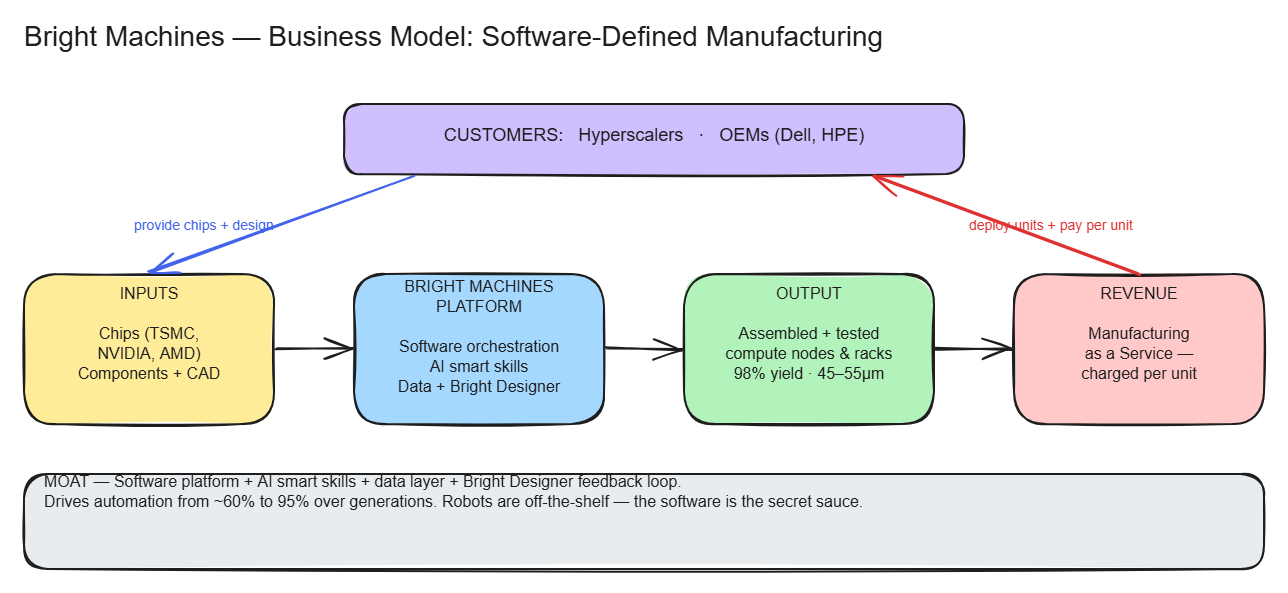
Bright Machines makes money through manufacturing as a service. Rather than selling robots, software licenses, or servicing hardware in the field, it charges customers per unit built — whether that unit is a single compute node or a full rack. The economics work because the units are expensive and strategic: when a compute node costs $50,000–$250,000, customers optimize for quality, yield, and time-to-market, not the $20-vs-$25 hourly labor difference.
How they charge:
- Per compute node — customers pay for each assembled and tested server node
- Per rack — larger integrated units built and charged as a unit
- Manufacturing-as-a-service engagement — ongoing capacity for OEMs and hyperscalers who prefer to service their own hardware for IP and security reasons
This model aligns Bright Machines with what customers actually value — throughput and first-pass yield — because a more efficient line means more billable units per site. With 40–50 compute nodes per hour from a single efficient line, capacity (measured in gigawatts) becomes the growth lever.
Distribution & Growth
Bright Machines sells into a concentrated set of high-value buyers: hyperscalers building their own designs, and OEMs like Dell and HPE. Strategic investors double as channel and credibility — NVIDIA's NVentures, Microsoft, and contract-manufacturer Jabil are all on the cap table, and collaborations with NVIDIA and Microsoft (via Bright Designer) deepen design-stage lock-in. Growth is capacity-led: more than 100 microfactories across 13 countries, and more than 3x growth in a single year.
Moat & Differentiation
The moat is not the robotic arm — those are off-the-shelf (FANUC, UR, various cameras and conveyors). The defensibility is the software platform that orchestrates the line, the AI "smart skills" that run the robots, the data layer captured at every station, and Bright Designer, which feeds manufacturing insights back into product design. That design-to-line feedback loop lets Bright Machines push automation from ~60% toward 95% over successive generations — a compounding advantage competitors relying on manual labor can't easily replicate.
Competition
Bright Machines competes with traditional contract manufacturers — Foxconn, Jabil, Flex — and Taiwan-based ODMs, plus the option for hyperscalers to build in-house. The wedge: those incumbents rely on large manual factories optimized for cheap labor, which doesn't translate to the US. Bright Machines wins where production must be local, secure, high-quality, and fast — i.e. strategic verticals like AI infrastructure, aerospace, and defense.
Why It Works (and the Risks)
The model works as long as AI data center CapEx stays strong (most of it is pre-committed for the next several years) and expensive, strategic units keep rewarding quality and speed over labor cost. The biggest risks: a sustained CapEx slowdown from hyperscalers, dependence on chip and component allocation upstream (TSMC, memory), and the possibility that the largest hyperscalers vertically integrate manufacturing in-house over time.
Takeaways
- For expensive, strategic hardware, labor cost stops being the deciding factor — quality, first-pass yield, and time-to-market take over.
- "Manufacturing as a service," priced per unit, aligns the vendor's incentives with the customer's throughput.
- The durable moat is software, data, and the design-to-line feedback loop — not the robots themselves.
This breakdown is based on our conversation with Sviat Dulianinov on The Startup Project.
Continue reading
More business model breakdowns
Business Model Breakdown
Postman Business Model Breakdown: How the World's Leading API Platform Makes Money
Postman is the world's leading API platform, used by 40M+ developers and 98% of the Fortune 500. This breakdown unpacks what it does, the job it gets done, and how its free-for-developers, monetize-the-enterprise model actually makes money — from our episode with Co-Founder & CEO Abhinav Asthana.
Business Model Breakdown
Vast Data Business Model Breakdown: How AI Data Platforms Make Money
Vast Data built a $30B AI data platform by combining all-flash storage, vector search, analytics, and compute in one codebase. This breakdown explains how Vast makes money through per-gigabyte subscriptions, Neo cloud revenue sharing, and enterprise infrastructure contracts.