Transcript: From Forbes to Founder: Alex Konrad on new media, creator economy, AI tools for journalists, Midas List secrets, and why traditional media is losing to independent voices
Full transcript: From Forbes to Founder: Alex Konrad on new media, creator economy, AI tools for journalists, Midas List secrets, and why traditional media is losing to independent voices. From Forbes to Founder joins Nataraj to discuss identify t...
2025-11-10
Listen to this episode
From Forbes to Founder: Alex Konrad on new media, creator economy, AI tools for journalists, Midas List secrets, and why traditional media is losing to independent voices
Nataraj: Yeah, he did three IPOs, and one of the things he told me back then that I've never forgotten is he said, the secret to his career was that he just always figured out where the engine room was in the business and organization he worked at and he wanted to be as close to the engine room.
It's it's a lot of survivorship bias. Like, uh, I think very few, the conclusion that I don't like how many people actually make money on YouTube is actually very close. I think it's it's more unequal than the real life.
There are kind of three main groups that I think are relevant right now. There's the Legacy traditional media folks, like a Forbes, New York Times, or others.
There's the new media, like me, like Eric Newcomer, you know, Alex Heath, you know, that whole sort of Substack or beehived ecosystem, and also journalists who do podcasts and shows.
And then I think there's the really good um sort of non-journalistic content creators.
And that could be, you know, TBPN, it could be some of these VC-led podcasts or or your podcasts, I ran the Midas List for 10 years, so I obviously wouldn't have done that if I thought it was like a worthless project, but we did work hard to like make it better while I was working on it.
And I think number one is it was 100% meant to be quantitative as much as possible. We We also wouldn't remove someone just because they said they didn't like Forbes, they didn't like Midas.
Yeah, I I I would probably stop the podcast because I can't, like I don't have enough bandwidth to do all the stuff necessary to get the podcast up, even though like I have some editor, uh, you know, working on it, but I still have to do a bunch of work before and after the after the process, and what I've learned as well, there are air tools, we I I can see it happening soon where I don't have to spend so much time.
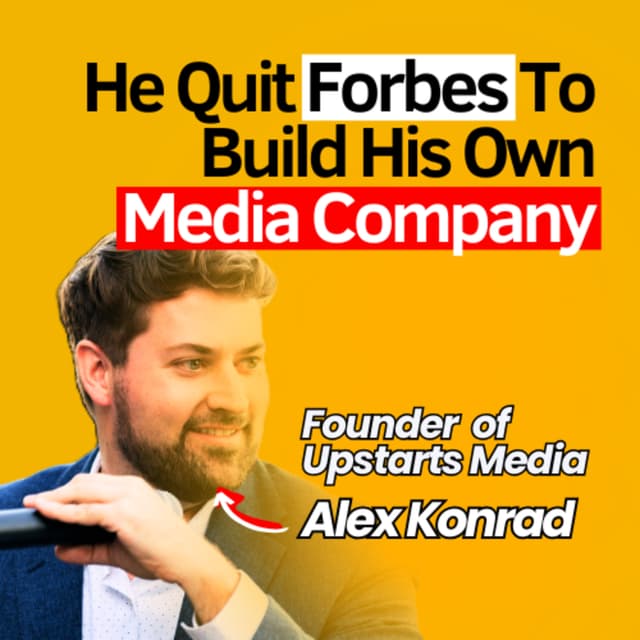
Nataraj: My guest today is Alex. Alex is the founder and editor of Upstarts Media, a new tech publication focused on the startup ecosystem.
He was previously at Forbes, uh for almost a decade, and was a senior editor at Forbes covering startups and venture capital.
Um, I think media today, um, you know, across segments, whether it'd be comedy, politics, startups, is sort of like moving into this decentralized long tail where, you know, there were a few, you know, big old tech companies or old media companies, which are sort of New York-based, uh what we call as traditional media.
And now I think we are seeing a sort of a new ecosystem evolve. At least there are new tech publications, they might be, you know, podcasts, and then they'll have YouTube channels. So, I think this conversation will be very interesting.
We'll talk about all that things and also, you know, what is a model for a new tech publication in the larger media ecosystem, where does that fit? Uh traditional media versus new media, how do we define those things?
And in general, like what are the storytelling trends and tips and things that are happening in tech startups and the venture capital world.
Uh so if this is the first time coming to your uh coming to Startups Project, don't forget to subscribe to us wherever you listen to us or on Substack.
Nataraj: Welcome to show.
Alex: Thanks for having me. It's fun.
Nataraj: Uh, so I think uh, you know, you worked uh a while for at Forbes. Forbes is just, you know, has this interesting cultural context, um, whether it'd in tech or in general, broadly in the world of business. Uh, what was it like, you know, day-to-day working at Forbes?
Alex: It was it was honestly a great place to to build a career. When I first joined, it was a long time ago.
I had just spent a couple years covering startups in New York City for another magazine, Fortune, and I joined Forbes actually as the homepage editor back when people cared a lot about homepages.
And I got to kind of, you know, cover uh startup interests that were not super well covered by my mostly West Coast team. So, being in New York back then, AdTech was a big area that I I downloaded.
I got to write about uh some early companies like Zocdoc, Blue Apron, General Assembly, and of course, WeWork. I wrote the first story about WeWork.
And I'd say, you know, first off, Forbes was valuable to me because especially early in my career, there was a high concentration of talent.
The Forbes alumni network, whether they're new creators, um like Laura Shin is an amazing crypto entrepreneur and reporter. She was at Forbes. Uh there there are folks across the ecosystem who who were journalists there at some point.
And learning from that high concentration of talent, especially in the office, was super valuable. It was also great to have editors and people kind of really helping me figure out the craft.
And then more recently, I would say it was a great platform to just meet amazing entrepreneurs and write about the ecosystem, whether it was, you know, Melanie Perkins at Canva or the Collisons at Stripe.
Like, you know, I I'd say Forbes was certainly a great door opener to get to, you know, meet with some of the most exciting people in tech. What what do you think, where does Forbes fit in
Alex: the today's tech media publications here? Forbes, Fortunes, you know, the OGs with the New York Times and uh Washington Posts of the world, but then there is whole a new broader tech coverage ecosystem.
I feel like, you know, there's Casey Newton who does the Platformer, and who also collaborates on Hard Fork. I think there is all sorts of like interesting next Alexander Bopotons. Like, where do you see Force uh Forbes fit in that sort of ecosystem?
Alex: Yeah, so at a high level, I especially now with Upstarts, I I say that we're uh sort of new media and Forbes and some of those other places are traditional media or trad media.
But I'd say broadly speaking there are kind of three main groups that I think are relevant right now. There's the Legacy traditional media folks, like a Forbes, New York Times, or others.
There's the new media, like me, like Eric Newcomer, you know, Alex Heath, uh Emily Sunberg in sort of the business side of things with with her Substack, Feed Me.
You know, that whole sort of Substack or beehived ecosystem, and also journalists who do podcasts and shows. And then I think there's the really good um sort of non-journalistic content creators.
And that could be, you know, TBPN, it could be some of these VC-led podcasts or or your podcasts, you know, uh Joe Cash, like there's amazing people, you know, who I'd say are not journalists but make good content.
So, I'd put Forbes on sort of one end, and then, you know, that on the other, and Upstarts is in the middle.
Then within Forbes, I'd say what's interesting is Forbes, The Wall Street Journal, CNBC, Bloomberg, they kind of write for a general businessperson, and so they can go deep on technology.
Like Forbes just hired an AI reporter who's really good from Reuters. They they they have continued to do good tech coverage even without me there anymore. But at the same time, I don't think they're writing so much for the tech insider crowd.
They're writing to explain tech to a wider businessperson.
And I think, you know, if you look at the New York Times, or the Washington Post, or some of these other publications, they're even farther removed from the tech insider, you know, they're trying to explain why should we know about OpenAI to people who are maybe skeptical about reading about OpenAI.
And I think uh you know, then then of course like the new media folks are much more plugged in, writing for a different audience.
So, I I I don't think that like, you know, there's a hot take like Forbes is dead or old, you know, traditional media has no future, but I think it maybe writes for a different audience and it kind of fills a different niche than where a lot of maybe your audience or the people I talk to currently sit.
Nataraj: Yeah, I think it it makes sense really. I think everyone has their own place because you even though like the individuals, smaller companies can do interesting things, I think there's certain things that bigger companies cannot really do.
Like, like you cannot spend two months on a project collecting facts and you know, doing a deeply investigative story, even in tech. That's not you possible for me, for sure. I don't consider myself any sort of like a journalist or anything.
But even for you who I'm assuming you guys consider yourself as, you know, this maybe a little bit you you certainly bring that sort of journalistic aspect to tech startups.
And you can do those stories but not at a scale where a Forbes or a Fortune or a Bloomberg can do. Um, so I think.
Alex: Yeah, I I would say a big difference is like I I consider myself at Forbes like a big game hunter kind of where like you do that big cover story on the Collisions or something and then you could kind of like reset for a week or two, figure out what you want to do next, you know, kind of like you know lick lick your wounds whereas whereas now that I'm still a journalist but I'm also a startup founder, it's like I'm doing a sprint and a marathon every day.
You know, it's like you go from this to back to business development, back to working on the next project, you know, so I have a lot more empathy with founders now because I understand that that challenge for sure.
Nataraj: Yeah. Let's talk a little bit about like the the part of new publication, right? Like what what does a new tech publication in 2025 cost you?
Is it is being on Substack, is it being on YouTube, is it being on, you know, having a podcast uh or is it, you know, having an event business?
I think it seems like all together and you have to start somewhere and expand it all these different directions to actually build a build the business. Is that a fair statement?
Alex: I think it's totally fair.
I, you know, we we saw in the sort of traditional media landscape that I grew up in, there were these seismic shifts that would be very disruptive to the newsrooms, to how we consume the content, whether it was then this pivot to video, which happened a couple times.
You know, there was a moment where all these news publications were being told, make videos for Facebook. Then it was make videos for TikTok or Snapchat.
And I think, you know, it's always been a real danger when media companies orient their their whole energy towards one medium or one style of storytelling.
And so I think what you see with new media players like like me and Upstarts is we're trying to kind of have multiple touch points from the get-go. So, from day one, Upstarts, for example, we're eight months in. I've hosted over a dozen events.
I have a, you know, really good conversion of free subscribers to paid subscribers who are also supporting my work. And then I have sponsors who present the free edition of my newsletter on a one or two month basis as well.
So, kind of three revenue streams right out of the gate so that I'm not overly beholden or risk uh risk on with with one of them if that makes sense.
Nataraj: So, how how much content are you putting out? Like, I have on a weekly basis, you know, is it about two Substacks or two stories, two startups that you're featuring, and then have a conversation and an event?
Like, how how does a new publication like think about its online, how much content do we put it out there?
Because there's so much content and, you know, consistently like, it's almost like feeding a beast, you're falling into this, you know, treadmill where you have to continuously run now, uh I think that's the difference between like being a your own publication versus okay, like I'll play right.
Uh like now you're keeping the beast.
Alex: It's relentless. It really is. I think this is true for any content creators or people who are trying to build a brand today.
You know, even if you're, let's say a founder or a growth marketer who's who's, you know, watching this, like, you're if you're trying to build an audience on LinkedIn or X, like you have to be posting all the time, right?
And I think you're right that it's the same with a media brand, just even more so. So, for me, I've published every week since we launched. We published two to three times a week.
And every week I try to have a launch or an exclusive about an exciting kind of earlier stage startup, either coming out of stealth or raising its first big funding round or sharing its revenue for the first time.
Kind of like a news moment where I can share about the founders, about the technology with the world. So, so earlier this week, I had one of these on a drone startup. Next week I'm writing about a really interesting expert network.
It attempts to use AI, trying to kind of jump around so it's not all the same topic every week. Um and then we also have a paid edition where I do more trend stories or deep dives or Q&As with founders that are maybe off a news cycle.
Um I also published some scoops about, you know, juicy or exciting things that that we heard about that didn't want to be announced yet, and all of that would go to my paid subscribers who pay less than the cost of a New York City sandwich right now a month.
Sandwiches have gotten way too expensive, but that's another conversation. But, um, for less than one of those, you can can support and get all of that work. And I try to publish once or twice a week there.
When we launch our own podcast next year, um hopefully in January, that's going to be even more work for me to be doing the podcast episode and hopefully two articles every week. It's it's going to be a lot of content.
I'm going to be very much in founder mode just grinding to get all of that done.
Nataraj: Who who are the people who are doing this well in in this particular category and I can give some my names on my own. Um, but I'd love to get your thoughts on like what are the practices they are doing in or who is it doing that's, you know, really well that you admire in terms of about if I follow their tips and tricks on how they're doing content, kind of in the space.
Alex: Yeah, well I would say, um, you know, there's I have a couple friends who are VCs who I think have really good podcasts, and I I've definitely learned from them. Uh Turner Novak is a good friend of mine and I love his Peel podcast.
Jack Altman um with his show does does a great job too kind of founder turn VC.
Um I also am friendly with the guys at TBPN and I think from a live news standpoint, I've learned a lot from them and I think their big insight has been to create potential viral moments by kind of having fun clips from each of their guests.
And I think that's something I take to heart. And then on the sort of Substack or newsletter side, one of my friends, Eric Newcomer, went independent from Bloomberg four years ago and um Newcomer has grown to have writers, employees.
They have a huge event in San Francisco uh once or twice a year called Cerebral Valley. And I think he publicly shared uh a year recap recently where he said they'll they'll do $3 million in revenue this year. So that was really impressive.
I I admire that. I would love us to get to $3 million in revenue, you know, even faster than four years. We'll see if I can pull that off.
Um, but I I learn a little bit from each of these different types of folks, whether it's on the podcast side or the newsletter side.
Um I've also really admired, I I mentioned before, but uh there's there's a writer named Emily Sunberg who has a publication called Feed Me, which is about sort of the intersection of culture and business.
She's built an amazing audience where she sells out merchandise um like has fans who like come up and want to take selfies with her. Kind of like the Acquired guys have an audience like that too.
Um, and I really admire how how all those folks have built a community, you know, that's that's really rooting for them and I hope that Upstarts we can do that over time too.
Nataraj: I didn't know but are really good. I um heard and you followed Newcomer's work and briefly met him when I was thinking of incubating an event series in Seattle.
And he was generous with his time to share it like how he built his, you know, event series and the way he approached and some of the tactics that involved.
Um I think for Acquired guys, the added benefit for then their structure is, they're completely dependent on their own time.
Uh they produce actually the fewest number of content in all the creators you mentioned, if you look at like how many episodes or how many calls But but on a but on a per minute or per hour basis, they still do a lot of work.
So those shows are really long, right? It's it's like three hours. on the on the output basis it's smaller. Uh so it tells you that if you can stick for the long term, you can approach it in sort of different ways.
Uh but I also feel like the, you know, all this category of creators, whether it's Newcomer or you or Casey Newton, I think you guys are all anchored on existing brand, and that brand helped you in terms of gaining some minimum attraction early on and then you've self compound on that.
Uh but it's really tough now to actually, if you're coming up with a blank slate, uh to build something, it will take much longer. Like Newcomer might have taken four years.
For someone without working at Bloomberg, I think that would be maybe eight years or maybe 10 years to get to the same stage. I think that anchor of it would import.
Alex: No, I think you're completely right.
Um When when I think about sort of people who have gone from scratch, you know, uh on the VC side, like Molly O'she with Sorcery, which is a newsletter and podcast, she's kind of started from no brand and built a really meaningful brand where she gets to partner with Brax and have big speakers on, like an Alfred Lynn from Secoya, etc.
Um Nicole Weshov is another VC who's been really aggressive in building a brand. I was excited to go on her podcast recently.
Um but on the journalist side, I think many journalists don't have the network or the brand to be able to go independent, and this is definitely a challenge where I think you're completely right that if you spend a lot of time building a community, building a name for yourself, this is an okay path to take, but I don't think that like every reporter at Forbes could go independent today and be successful.
It's it's unfortunately a lot maybe like trying to make money making TikToks. Like I think we've seen a lot of data that most creators on YouTube and TikTok don't really make a lot of money, right?
Nataraj: Yeah. And it's it's it's it's a lot of survivorship bias, right? Uh I think very few, the conversion rate on like how many people actually make money on YouTube is actually very close. I think it's it's more unequal than the real life.
It's it's the power law. I mean for for people in startups, we all hear about the power law, right?
And it's like I think in creator, in the creator economy, and I think kind of in the journalistic side that I'm doing, it's really hard to be in the middle. You know, it's like either like you are the elite or you are a challenger.
I'm dealing with this candidly still right now where, you know, if I'm if I'm pitching sponsors on Upstarts, our newsletter is growing every week, but it's much smaller than like Lenny Rachitsky, who's built an amazing brand, right?
And so, if if you're comparing just raw audiences, I'm never going to compare at least for a long time to Lenny, and so I have to hope that Upstarts is bringing some different value, a different kind of uh reason to partner with me than just the size because on a on a power law size game, like Lenny is an order, you know, he's he's in a whole different stratosphere, right?
Tell me if like talking about pure distribution, right? I mean, um obviously you're writing the content, um and you're assuming you're launching the podcast. Um, how's the distribution?
How are you thinking about distribution because I feel like over time, you have to post in many places, but you have to find one distribution channel that really works for you and where you can, you know, where you somehow you've convinced the algorithm that uh your content is worth amplifying, right?
So that it's all about convincing the algorithm at this point. Um so which sort of distribution channels are working, which distribution channels are not working? What what has been your experience like?
Alex: I think uh, from a social standpoint, LinkedIn and X continue to be good channels for me because as you kind of noted, I already had audiences there of tens of thousands of of subscribers or followers.
So they've both been pretty good channels, um, but it's been very hard to build new channels. Like Threads and Blue Sky are not major sources for me. Chat GPT is a top 10 referrer to my site, which is kind of interesting.
I I think I should lean in more or figure out how to make sure that Upstarts is being surfaced when appropriate in perplexity, in Claude, in Chat GPT.
Um, and then I think from like, you know, there's a Substack recommendation engine that's gotten me a bunch of subscribers.
I think I could do better to engage more with my peers on Substack, you know, whether it's collaborating or commenting, just kind of being part of the conversation there.
Because I think, you know, the reality is there it there aren't a lot of equivalents to like YouTube's recommendation engine where like at least theoretically YouTube is like, you know, you will get into the long tail of other people's videos and you can build an audience passively.
I feel like my experience has been that you have to build an audience very actively. Like like if I if I don't share my work, as you said, relentlessly, it doesn't get noticed. So.
Nataraj: Yeah. I I think yeah, it sort of like um People who got early on on Twitter have an extremely good advantage.
I think at least my personal experience has been actually that Twitter algorithm deteriorated massively and it doesn't actually has um any kind of sort of like elevation for the new accounts at all.
And I think you have to say basically some kind of uh extreme opinion, taking extreme opinion on some sort of issue, and that's how you basically now get Twitter views. so I've been really disappointed in terms of like what Twitter algorithm has become.
I mean I know it's very hard.
Alex: It's very hard to build. I think you're right. I think my engagement is better than it used to be.
I think like Nikita Boyer, the the new head of product has has improved some things because I I feel like I got even less engagement a year or two ago.
Um but I agree that it feels to me like the era of hyper-growth and like a total meritocracy of building followings on Twitter is is over. It was in the past.
I think um that's one thing I think about with Substack and as we launch on YouTube as well is like if if those are also kind of saturated markets, how do I just keep getting in front of people because there is a cold start problem I think everywhere.
We're just in a very fractured information economy right now.
Nataraj: Yeah. And I think the algorithm has actually basically is done at this point on X, and this might be a little bit to say. Um and I think the good times of like the peak usage of all also behind it today.
And I think the next my personal experience has been threads is where people are going to move uh because uh Blue Sky I think it's still smaller, it's not gaining like beyond certain level.
I think threads is the only one that's gaining wider traction. I see everyone who's. What kind of personas do you interact with mostly on threads? Or like do you see certain communities have really moved to threads? Or like what Yes, I think.
Nataraj: What has resonated, yeah? So I actively use Twitter for because I post constantly and try to make sure my videos get posted on Twitter and also threads.
Um so I I definitely see that everyone who I follow on Twitter is now actively hedging their strategy on threads. So, and they are sort of gaining traction.
Um and I've not been really good at posting on threads and I've just started looking at when I when that statistic about threads being well there you know, threads increasing their usage just come out.
And yeah, once that came out, I said, okay, what is happening on threads? And I started, you know, engaging more there. And I've seen that everyone who has a bigger following and I'm only talking about the tech and VC space.
I'm not talking about like, you know, any other other politics or comedy though, but then generally like the same people are because my timeline over the decade has been perfected towards technology, AI, and VC sort of space and all the big accounts are actually posting on threads.
Uh, me, I think only a very small percentage is not actually posting exclusively on Twitter and not on threads.
Nataraj: So what you should say. Everyone started hedging their bets with the threats. And which is actually a sign that Blue Sky is losing, threats is winning. I think threats has the potential to be the sort of like OG Twitter algorithm.
But that's, you know, honestly, it's kind of annoying for me to hear that because if I already have audiences on X and on LinkedIn, what that basically tells me is I need to be investing even more time in a third channel, right?
And and I think that is that is a problem for people like me who already have limited bandwidth, like that we have to basically, as you noted, post in all these places.
Like when I publish an article and it goes out to my newsletter subscribers, they at least get it automatically, but then I have to spend like, you know, sometimes up to two hours just promoting and sharing the work everywhere else, right?
And it it does feel like a chore to kind of go down the checklist of like, here's my asset for LinkedIn. Here's my thread for X, and now I guess I should be doing more thread posts as well.
Nataraj: Yeah. And I think that's what I'm hoping some of the AI tools are actually helping out. I think you can, because I'm an individual creator, I'm not actually monetizing.
I think about monetizing, but I want to experiment with that as many chances as possible and compound the effect as much as possible and I think AI is helping that do that better.
A pre-AI, I would probably stopped the podcast because I can't, like I don't have enough bandwidth to do all the stuff necessary to get the podcast out even though like I have some editor uh, you know, working on it, but I still have to do a bunch of work before and after the after the process.
Um, and what I've learned as well that air tools we I I can see it happening soon where I don't have to spend so much time and drastically the amount of time I spend on whether researching a guest or, you know, generating assets after the conversation.
Um, I think uh drastically reduced that time. Uh and I think we're seeing more of the tools sort of like going to give us that um uh, you know, it allows more independent creators to monetize their original work. I think we will see that soon happen.
I think there are some tools that are getting really good at doing that. Uh and I'm hoping that in the next one year it should compound the fact and uh I don't have to worry about posting on triple and threads.
I just post something and then it goes everywhere.
Alex: Yeah, I'm really excited for that because I think, you know, one thing, one kind of irony is that I've been doing this long enough that I played with those tools before generative AI, when they were just kind of like automation flows and they weren't quite there, you know, it actually would create more work than than not.
And so, I'm someone who's kind of like been burned by that before. So I'd be less likely to be excited to be an early adopter now.
But if but if there is a perfect experience where I just write a post and an agent shares it correctly across the platforms, of course I'll adopt that once it's like fully worked out, you know?
Nataraj: Yeah, I think the difference this time is um AI can adapt to different personas. And I think the products are not yet there even though the capabilities are there.
So actually it's more about, you know, finding the right abstraction and how to create the new buffer or new, you know, uh tooling that actually makes sense because it has to be at a level where as an individual I can modify the flow.
It doesn't it shouldn't be like one way to do things. and that was the problem with the SAS of like there's only one way you try to force fit uh into that model of scheduling or like I post here and then it goes there.
But I think there's a level of personalization you can bring using AI that was not possible before. So the the even what we used to call as workflow or automations are extremely more powerful when you add AI primitives in it.
Uh so I think that's where the magic is and I'm seeing a hint of magic and it can talk about it. Um you post a call and I can show you some tools that are actually working.
Um but I I also want to ask you about, you know, one of the most biggest conversations in VC Twitter is Midas List uh and I think you are the closest person I've talked to to work on. Uh so tell me about like in Midas List.
Like how seriously people take it uh in a VC lot of controversy when the list comes out. Uh is it a quantitative list or a quantitative list? How should we actually look at it? And what are VCs telling about Midas List of the Twitter?
Alex: Yeah, totally. So, I ran the Midas List for 10 years, so I obviously wouldn't have done that if I thought it was like a worthless project. Um, but we did work hard to like make it better while I was working on it.
And I think number one is it was 100% meant to be quantitative as much as possible. So, one one big difference from a couple of the lists that we've seen try to compete with it is there's no opt-out mechanism for Midas.
If if the model thinks you should be on the list, we would have put you on the list whether, you know, whether you like it or not. And that created a fairness I think that was really important.
We we also wouldn't remove someone just because they said they didn't like Forbes, they didn't like Midas. So it was never about playing favorites. Um and I think that was a really important thing.
Um you know, we'd have people claim there were politics involved and we could always say, well look, you know, if you're if you're a left-wing VC, there are other left-wing VCs here.
If you're a Trump-supporting VC, there are other Trump-supporting VCs on there. I It it happened after I left, but you know, David Sachs who's involved with the current administration, he he made the list last year.
So it it it's non-political, no favors being played. It is a mathematical model. And then the question was how could we always make the model better and better. So, the Midas List has been around for 20 years.
It it pre-dated me and it obviously will continue long after I I left Forbes. And I think the value of that is you do have many years of historical data.
And so they have data every year on over 100 firms, thousands of partners, and they can use that to triangulate you know, missing gaps or if there are discrepancies and people trying to rewrite history, that is a very valuable proprietary data set.
And I think people, you know, people may not see that because you're not going to share your proprietary data with the entire world, but like, you know, that if we think about it in the era of AI, like, you know, Chat, GPT, Claude, all these places, you know, the models keep getting better, where is their value?
If you're like training your own model on your own proprietary data. Forbes kind of has that similar thing with its database of of VC information. They also partnered with a fund of funds called True Bridge, which I think was a smart move.
It happened before my time, but they continued to work with them since, and True Bridge brought in a bunch of firms and like, you know, credibility to share that data.
Then once a lot of firms are sharing, it's a lot easier to go to a big firm like an Excel or, you know, Index or whoever and say, well, your peers are submitting data and we just, you know, the more data we have, the more accurate the model is, so please please submit.
Um, and it was it's always confidential. Like I wouldn't be looking at it as a reporter. So, I think that that all really helped. Um, but, you know, it's it's an imperfect model.
I think the biggest the biggest challenge that I always felt was that it's a multi-stage list. And so you have seed investors, you have growth investors, you have a 1000 or 10,000 X small check, and then you have a 10X or 5X huge check. Yeah.
And so we were kind of like, how can we make a formula that reflects bigger and bolder bets that both rewards the huge multiple early early stage VC and the huge cash return late stage VC.
So we tried things like like like, you know, um modifiers or weights, and we like we would experiment a lot to try to kind of have multiple ways to win on Midas.
But I think a reflection of the limitation with that was that while I was still at Forbes, we launched the Midas Seed List as like a auxiliary list for just seed investors because the model just like couldn't fully reconcile seed investors as easily with those big growth investors.
So all of that is to say, I think, you know, the Midas List is done very thoughtfully and mathematically and it has a real moat that is hard to crack.
You know, every year or two you'll see someone try to do a competitor and I think they find that it's just like 100 times harder than it looks.
Nataraj: Yeah. I think that everyone has that sort of uh big list that make, right? Like Times has time 100, uh Fortuna has Fortuna 500, Forbes has Midas list, 30 and 30.
Uh right, which also has available for meme and you know, 30 to 32 uh pipeline. 30 under 30 is a fascinating question because I think the biggest frustration with that one was you know high high downside risk if if someone ends up not being as great as you think verse disproportionate to all the great people you have on, right?
So Yeah. So if someone has raised, let's say $100 million in the ecosystem, everyone thinks they're amazing. Like they have all this momentum, of course they're going to make lists, right? But they're going to be able to raise from the best firms.
Like everybody will celebrate that person. Like let's not let's not forget that Secoya had a big glossy interview with Sam Bankman-Freed on their website until FTX went under, right?
And so if the whole industry is celebrating someone, it makes sense that they to make a list like that.
And then I think the challenge for Forbes is they become a meme as you're associated with like a few of those people even when statistically it's, you know, most of the people on the list are great people that you and I don't don't really even know, but they're just like solid people, you know what I mean?
Nataraj: I mean the younger you go on age bracket, the is your the list is because you you don't have a reputation to go off of. So it's sort of like that is built into the structure of the list because you're
Listen on Spotify | Apple Podcasts Subscribe to our newsletter More at thestartupproject.io