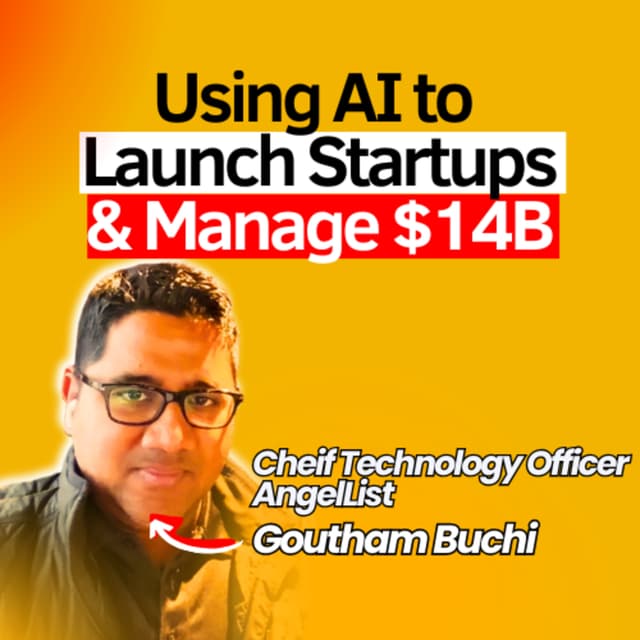
Transcript: Automating Startup Formation, Scaling Fund Products, Applying AI Across Venture Tools | AngelList CTO Goutham Buchi
In this episode of The Startup Project, host Nataraj Sindam interviews AngelList CTO Goutham Buchi. They discuss how AngelList is using AI to automate startup formation and fund deployment, the shift from AI as a research problem to an engineering one, and how the platform integrates crypto like USDC to improve capital efficiency. Goutham shares insights on building venture tools, the future of AI in finance, and the blurring of roles in the modern tech company.
2025-08-03
Listen to this episode
Automating Startup Formation, Scaling Fund Products, Applying AI Across Venture Tools | AngelList CTO Goutham Buchi
Nataraj: The hard problem in most companies is actually working with legacy code.
It's not a greenfield code, like the hard problem is like, Now, the moment you are able to put things in place that can abstract the legacy away from you, or even better, intelligently retool the legacy for you, you're taking like a ton of work out of the way.
Folks are able to like literally join and start deploying same day, right? And it used to be one of those aspirational things.
I think a good mental model that I use is, if you think of a triangle where one one corner is the founders, the other corner is the GPs, like the serios of the world, and the third corner is our LPs, people who want to invest in early stage venture or venture more projects, right?
Angel list is Mac in the middle of the triangle, right? Our sole purpose is to make sure that the sides of this triangle are getting stronger and stronger because these these three are the pillars of innovation economy.
Nataraj: My guest today is Gautam. Gautam is the CTO of Angellist, a platform that is used by startups, investors, and fund managers. Many of my startups investments have been on Angellist. So it's nice to have Gautam from Angellist.
Gautam was previously Senior Director of Engineering at Coinbase, co-founder and CEO of My Secamore, which is a Y Combinator company, and was engineering lead at Corcera. Today we'll talk about a couple of different topics.
One is the business of Angellist, how Angellist is leveraging Gen AI to build new products and features, and how are they innovating beyond the status quo by supporting some of the crypto primitives.
If this is the first time you're listening to the startup project, thanks for joining in and don't forget to subscribe to us wherever you're listening to this podcast. You can also subscribe to us on substack at startup project.substack.com.
Nataraj: Gautam, welcome to the show. Gautam: Thank you. Really, really excited to be here.
Nataraj: So, to set the context for the conversation, can you give a quick introduction, a two minute intro of you know who Gautam is, you know, what what was your journey before joining Angellist as a CTO? Gautam: Yeah, for sure.
Um, I mean, I'm not going to rehash the things you just said, um, but I'd say my journey largely revolved around uh key levers that can personally change someone's life, which is largely education and access to financial tools, right?
It started at Courseera where we tried to democratize access to good education and then moved on to my own company, like furthering that journey, and then to Coinbase, which democratized access to better financial tools and using crypto as a methodology.
Now, I'm continuing on the path to democratize access to capital, right? Uh and access to capital is probably the single best innovation and hack we could do to creating more startups.
And Angellist is in the business of creating more startups, creating more tools for the founders and builders. And I'm really excited to continue that journey there.
Nataraj: Talk a little bit about uh for those people who are not aware of Angellist, I mean, if you're a founder, you know, who's explored Angellist products, or if you're an investor was raised on Angellist, I think you're pretty well aware.
Most of my startup portfolio is actually on Angellist, uh and my investing journey started with the Angellist India actually.
Um so talk to me a little bit about what are the different products on Angellist uh and you know, what are the core business drivers among those products because you have rolling funds, you have venture funds, you have syndicates.
Uh talk a little bit about that. Gautam: Yeah, for sure.
I think a good mental model that I use is, um, if you think of a triangle where one one corner is the founders, the other corner is the GPs, like the serios of the world, and the third corners are LPs, people who want to invest in early stage venture or venture more broadly, right?
Um, Angellist is Mac in the middle of the triangle, right? Our sole purpose is to uh make sure that the sides of this triangle are getting stronger and stronger because that these these three are the pillars of innovation economy, right?
So, the first thing you have to believe, right, to believe in the mission of Angellist is that startups are good for the world, right? Like creation of more startups is the way we innovate and is the way we accelerate innovation.
Now post that, we need to identify, so what are like how do we really strengthen each of these pillars and like the founders, fund managers, and people who want to like, you know, invest in early stage venture.
And I quickly talk through uh what we do to actually strengthen these pillars. So if you're a founder, um, and maybe surprising to a lot of people, like Robin Hood's first check was on Angellist.
Like, you know, there are many, many companies through our REV product have been able to come in and then say, okay, I'm looking to access good capital, right?
And not just dumb money, but like good capital on the platform, I can go to Angellist and start a company, right? Uh many of my friends have raised on Angellist as well.
So we are creating an ecosystem for founders to really take the mental gymnastics around starting a company to really focusing on like, you focus on building the product, we will then the rails for you to get the capital that you need, which is our RV product.
Now moving on to the other corner of the triangle, which is you are a fund manager, right?
Let's say you are the um uh like you're somebody who is like a you have a unique hypothesis, you have a unique insight into where you think you can be investing, like you know, to accelerate this innovation, right? So what do we need?
You need two pieces. You need access to good founder opportunities, you need access to good capital that is looking to be invested into this. Uh so that is our core fund admin product, the core GP product.
And this is probably the one that Angellist is well known for today.
Right, you need a lot of tools, so you don't again, like spend time uh doing the gymnastics of how do you like actually raise capital and how do you deploy capital, but really focus on what can you do to add maximal value to the founders, right?
So our core customer today there is the fund managers. And the third corner of that pillar is, um, the uh people looking to invest in early stage uh or venture more broadly.
Now, this is probably the one that most people have historically known Angellist for, right? Wherever you're in the world, if you're like, okay, I I want to like invest, get access, I believe in the startup economy.
I want to write my, I don't know, thousand dollar check to like $100,000 check. I want to be an angel, right? You go to Angellist. Like there's literally angel in the name, right?
Like this is the thing that Naval has envisioned around, how do I really democratize the access to early stage venture uh across the world?
And um so we provide a number of tools for people who are looking to get their kind of like get their toes wet uh in in in the in the world of angel investing uh whether through LP capital products and these are again our primary customers, right?
Uh to sum it up all, right? The way I would think about Angellist as a business is, kind of like really think about the triangle between founders, GPs, uh who are looking to run the fund, and then angels, right?
And the speed with which we can spin the triangle is essentially innovation.
Nataraj: So you joined Angellist uh I believe this year or last year, um and you've worked in different companies, you know, how is working at Angellist different from working at say Coinbase? Gautam: Yeah. Uh very different.
Uh well, right off the bat, um, All in 2017, 2018 was very different than crypto right now. Right, like to give a specific anecdote there.
If you and I met in 2017 and if you told me that, hey, by 2025 you would have Bitcoin ETF, or we would have stable coins, most people in crypto would have laughed.
It is one of those amazing things where, um, the pace of innovation is so constant, so relentless, and quite frankly, very uplifting, but there is always this overhang of regulatory, like, you know, uh, on top of you, right?
And there were many times especially uh over the last four years uh where being at Coinbase felt very much like you're fighting a big institution. You're fighting a regulatory battle, right?
Um, that is not something that we face at Angellist day to day. Uh you are like, there is a you don't spend thinking about regulation in the way that you would think about, you know, crypto world.
You're really thinking about how do I accelerate capital deployment? How do I bring more efficiency to how capital is being deployed, which is a very different problem space. That's one.
Second is uh to give specific examples of like, you know, how this is more about how Coinbase and crypto are different. The pace of innovation in crypto is insane, right?
Like, you know, we had a joke at Coinbase that one year in crypto is like 10 years and there's a popular meme where, you know, uh, five years in crypto somebody becomes has this white beard, like gray hair, right?
It's very true, you know, I can personally attest to it, right? Um, and so is eternal optimism, right? Uh, so when you uh, crypto, crypto crowd is probably one of the most optimistic crowd that I've ever worked with, right?
Uh it's it's it's different, like, the capital products while innovation does happen, not at the same pace at which it's happening in the crypto.
So what that means is the way you think about product, uh, you're thinking more from a reliability lens, you're thinking like, you know, longer term, uh, which is very different.
Now, for the companies particularly, obviously Angellist is much smaller, much more earlier stage. All in all, we are about 150 people. Coinbase when I joined was probably a few couple of hundred, I but also is now a much bigger company.
Uh so definitely it has its own pros and cons.
Nataraj: There is one uh true line I see between Coinbase and Angellist, which is uh both sort of were involved in major regulatory changes.
Um Naval and team were involved in Jobs Act uh earlier in the day to sort of change and sort of make Angelist and crowdfunding happen really because of Jobs Act and you know, things that were part of Jobs Act led to uh some of the changes and some of the products on Angellist and now I think we are seeing that happen in real time with some of the crypto um legislative changes.
Uh so that is a sort of like a true line in both companies. Um, so I want to pivot towards uh, you know, majority of what I wanted to talk in this conversation is about AI.
Uh you know, post chat GPT, I think, uh before chat GPT, you know, I had friends working in machine learning, but we couldn't see like, okay, we're doing recommendation systems, we're doing, you know, sort of predicting text in some format, but we were not able to squint our eyes and see what is next.
But once GPT came, then you sort of saw that, okay, you could do a lot more with this current technology. Um, and in my career, I think, uh this is sort of like a game changing moment. It is one, I was not a huge, um, uh, what do you say?
Like I I wouldn't say like a, hey, go and bet your cate on crypto person, but I would say like, hey, you can go ahead and bet your career on AI person.
Uh so that at least I in terms of like big technology arc shifts in my career, I think AI is the first one because by the time I came to work place, you know, mobile has already been there, search has already been there.
I think premiumly we grew up in the SAS era where you're creating new SAS products and you know, B2B era where you're selling B2B SAS products. I think that was sort of like where a little bit of stagnation in terms of new ideas.
I think crypto was the only exception in terms of new ideas. That is sort of my this is going to be a long really big cycle of innovation.
Uh but I wanted to quickly, you know, get your thoughts on, you know, what you think of AI in this current AI hype cycle, um and your general or 20,000 feet thoughts about it. Gautam: Yeah, for sure.
Um, let me dial back the clock a little bit here, right? Um, I don't know if uh if if you if your audience is familiar with uh Corcera, you know, it was an education platform that started in 2011.
And our first major success was a machine learning course by Andrew Wing, right? So we all work for Andrew.
Nataraj: The course I've taken, a lot of my friends have taken out of college because Andrew.
I mean a lot of people don't know, but like he pioneering machine learning in a lot of ways, like especially education of machine learning, I think there a lot of credit goes to Andrew. Gautam: Yeah, 100%.
I can I think a lot of people, especially in deep learning, probably got their start with Andrew.
And at Courseera we were incredibly excited about it and not just from a pure like technology perspective, but also uh the the audience and the learning, like, you know, these were the most subscribed courses on the platform, right?
Now the thing that was different back then was it was still largely a research problem.
So it's the sort of thing where you want to where you want to involve at an intellectual level, but it was harder for you to think about what is an actual go to market motion.
Even back when I was starting my own company and 2016, 2017, there was a running job between YC that hey, all you had to do was attach AI to your domain and you automatically would raise a bunch of money.
So there was definitely like, you know, hype cycle number two also happening in 2017. different about this particular iteration is, uh one, it is it moved from being a research problem to an engineering problem, right?
Where you could say like, yeah, I'm going to like take the model in a box, assume that somebody has already done all the heavy lifting.
Now I'm really trying to figure out what are the, what are the other things in the ecosystem that I need to connect to actually make sense of out of this. And that's been incredible to see. Second is, um, utility of it, right?
Is the is the utility back in the first, I would say cycle of like, you know, at least my experience, 2012, 2013 machine learning, 2016, 17 AI is the utility, you really have to squint your eyes and like, there was always human in the loop, there were many AI companies back then with many human in the loop, like, you know, practices and processes.
Uh and the utility was not uh obvious, right? Like you know, you had to bet that hey, one day this thing will actually be at a point where uh you will see like, you know, real feedback and real feedback loops.
Um, but we are in a world where like, you know, you can parse a PDF instantly in a couple of seconds, maybe less than a second now, or you could do voice translation. So what that does is that so now you bring these two ideas together, right?
It's an engineering problem, utility is instant, so that means you have a very fast feedback loop, right?
You and I can spend the next 20 minutes and then we can literally build something, like to put it out in the world and actually see how people are interacting with it. And uh that is very, very powerful.
And uh that obviously let you like, you know, a lot of adoption and like nothing that we that we were seeing in the last couple of years. So that's one.
Second is a lot of what's happening today reminds me of like um, so my first start was actually at Bloomberg, like, you know, this was 2008 or so.
And Bloomberg was a very traditional finance company based out of New York and all of their deployment was on like actual physical machines, right? They owned their data center.
The idea that we would move to a cloud was so crazy back then, like, you know, AWS was just taking off in a reasonably big way, but it was just like seemed pretty crazy that like, you know, you would someday be like deploying all of this in cloud, right?
But now most people don't even like think about it.
Like you're not I I don't know if people remember this, there were companies like Rackspace, like, you know, that was super hot back then and people would be like talking about, oh, did you get access to the latest chip?
Um, and I reason I I I bet that most founders who are starting companies today are not actively thinking about what specific machine is being deployed in their AWS cluster, right?
They're assuming that compute is available, resources are available, and they're really focused on a different dimension of the problem.
I think about AI similarly, in the sense that uh I think four or five, maybe even sooner than that, we won't think of AI as like an extinction, it's more like something that you just naturally assume is already happening, right?
Uh just the way you think about cloud deployments today, right? You know, it is not integral to your strategy.
You assume that that capability is already there and you're going to harness it and then you're going to like, you know, take advantage of it. Uh so that's been like really fascinating to see, right?
Uh so how does that translate to uh let let me just pause there if before saying.
Nataraj: Yeah, I think um, I think what you're saying without actually saying it, it's much more of a horizontal shift. Uh or like if it's the best way I've heard this being described is, this is sort of like an you've added a new intelligence layer.
So just like we've added a horizontal cloud layer where everything can be deployed, uh I think now we have adding a new horizontal intelligence layer.
So that's where you see like pretty much every app that is existing that we use has some use case already implemented uh using AI. Uh similar to like every app that was on premises could be moved to uh cloud.
It just took some time for us to change our mind and then the tooling to get there. And with AI it's much more easier because everyone has access to API and we all build using APIs all the time, so it's much more easier to adopt as well.
So it became very quickly, we saw this massive adoption.
Um, so what do you think of the use cases that are most exciting for you uh as a CTO, uh and also talk a little bit about, you know, how are you at Angellist adopting AI in you know, different ways. Gautam: Yeah.
Um, yeah, there's two interesting questions there, like, you know, what is very cting to me sitting where I am, and also what is very exciting to the business, right?
Um, to me on the first one, it is so interesting to see the blurring of the roles, right? Um, like like I say, even three years ago, if you want to build an MVP, uh what do you do?
Like you're like, okay, first question, who's going to be the designer of this project? Next question, who's writing the PRD of the project? Then there's like discussion around who is going to be building this project, right?
Uh and then that's a lot of overhead, like, you know, I mean we might not have realized it three, four years ago because we all took it for granted, just like we all took it for granted that we all need to be in a building to actually do the work, versus like, you know, now oh yeah, this idea that everybody has to go to a place to just work seems a little bit crazy.
Uh so this this sort of like hey this very well defined compact in a box role is very much the norm, right? Like you know, even back in 2021, 2020.
Today, like our chief legal officer like, he tweets about it, he he builds end to end product himself, right?
Like that includes the design, that includes the spec, PRD, he releases it, he's tracking analytics, our designer is building like end to end products, our intern is building end to end.
So we really went from like role in a box to product in a box, right? Like effectively we we have like this full spectrum of skills that are very much available to you.
So what that means is, uh previously for you to convince me that, you know, hey, we should invest in that now effectively became, here's what I've already done, like, I spent like half a day, like I wipe coded it or like you know, whatever, and here's what this thing is going to look like, right?
And the conversation has become so much more sharper on a day-to-day basis to a point where uh I think like it's already happening in many of the SF-based companies and I remember I think it's going to only accelerate this, this idea that you have to go through multiple iterations to even define what you're doing will become so outdated and the roles become so blurry, right?
It is increasingly becoming hard to say, like, you know, what is the role of a product person, the engineer, like, you know, things we have taken for granted. So that's very interesting to see.
Second is, again, staying with the theme of what do I see like, you know, interesting changes happening is uh something that probably most of the audience is aware of is uh the your ability to uh deploy and get the boiler plate out of the way uh has been like huge, right?
So I wouldn't go too much into it because most people probably have been exposed to Cursor or Windsurf or any of that, like you know, because the hard problem in most companies is actually working with legacy code, it's not a greenfield code.
Like the hard problem is like, now the moment you are able to put things in place that can abstract the legacy away from you or are even better, intelligently retool the legacy for you, you're taking like it it it ton of work out of the way, right?
And that's been like very interesting to see. Uh we are able to now see, um folks are able to like literally join and start deploying same day, right?
Uh it used to be one of those aspirational things, like, you know, where we would say, yeah, like we would love for you to deploy on day one. Now it's almost like an expectation, right? Right now. Uh because of all the tooling is available around you.
And the third is, um um sort of kind of goes back to like what is what the the phrasing you used, like, you know, what is the base level expectation, right?
I have this view that it will be increasingly hard to see a good role for yourself if you are if you don't become very quickly AI native, right? Meaning being able to understand which tools create maximal leverage.
Um, and it always it almost feels like, am I late? You're not late, but now is a good time to start, right?
Because I can clearly see teams that have adopted AI and the way they are shipping, the way they are moving and the teams that have still lagging behind, the difference is so clear, so obvious, right?
Um, that we have now a default expectation that like, you know, everybody's trying out this tool, right? Even even if you're skeptical to begin with, go try it, experiment with it because more and more that is becoming the default expectation.
Nataraj: And one of the teams that didn't try or like not AI native, what do you see the blockers or like what is preventing those teams to become AI native versus one team becomes AI native? Gautam: Yeah.
Uh I don't think it is a philosophical stance or anything. It is it is more of a inertia and momentum thing or you could also be skeptical to, right? You could say like I don't maybe not quite delay with, right?
And for what it's worth, I was skeptical at one point as well.
I like if you are an engineer today and if you are not tried one of the uh uh that the the IDEs like, you know, like whether it's a Cursor or Windsurf or co-pilot, doesn't matter, like whatever like Tickles your fancy, you're already behind today, right?
And we see it, right? We see it like day to day, right? Uh so inertia could be a big component of it.
Uh second is, there are some good reasons not to do it by the way, depending on which team you're in, like for example, um if you're in security or if you are in a very, very critical path where you do want to make sure you're spending that extra time attention.
Uh and there are like Coinbase is a good example, like we had a lot of concern internally around what we might accidentally expose, right? Because a lot of these are also like primitives that are being built right now.
So, uh that could be some other reasons, right?
Nataraj: Yeah, I think I always call AI is right now then it's draft AI because it it gets you the draft pretty fast, pretty quick.
Uh but if like I'm reporting to my leadership, you know, business numbers, I want to at the end of the day depend on myself to review each of the lies even if I use AI to write it or you know, draft it.
So like you can see that pattern pretty much play out in everything. Like, you know, there are companies which are generating short clips, you know, based out of your videos.
It is pretty good at getting to the 95%, but, you know, it will make a mistake on that 5% and the title will be wrong, the guest name will be wrong or, you know, the description will not actually match with what it you want to say or it's too cheesy or it's too, you know, not matching your style.
So that 5% is where I think you still need the manual intervention, but that 95% is actually a really big, big time savior. Um, can you talk a little bit about, you know, uh some examples on how you're using AI in your own products uh in Angellist?
Gautam: Yeah. Yeah. Now that comes to part two, right? So, let's talk a little bit about like our customer type because then I can tie it to like how the products could be built.
On a typical fund deployment, let's say you want to like say, okay, I have this specific point of view on where I think innovation is going to come from.
And I have this group of people out there who are willing to back me, like, you know, let's say you want to raise a $50 million fund or $100 million fund, right?
There is a lot of workflows you go through that are sequential whether it's legal, like, you know, that are extremely boiler plate, that are dependent on a lot of like movement within whether it's Angellist or other similar companies, right?
There's a lot of internal workflows that that need to be executed on, right? And one of the metrics we track religiously is, how long does it take for you to actually like, you know, deploy your fund or raise your fund or get set up for the fund?
And we are increasingly using a lot of AI and automation to do that, right?
Uh our things like on a um, this might be surprising, but it's actually more common than people think, like, you know, you might have signed a legal doc that said something here and then maybe like, you know, because usually in a fund formation, there are like tens if not hundreds of docs that you are working with and your investors and whatnot.
And uh you you could have like said something else, like, you know, without inadvertently or without realizing that that completely changes the structure of how you think about your fund.
So we, one of the things we do is like doc parsing, like, you know, being able to parse a doc and being able to give the information that is very relevant to you and being able to automate your deployment, uh which reduces again, like, you know, going back to the theme is the thing that we always think about is how how do we efficiently deploy this capital for you?
Right, right. So that be integral to that is, how can we simplify the fund formation? That's one. Uh the second is, uh so I'll talk about operational and I'll also talk about the specific products in a second.
Uh so once you have your fund deployed, right? Uh the thing that Angellist is known for a lot is uh the venture association and the quality of service, right? Um, and it comes at a cost, like, you know, we take it very seriously.
We want to make sure that you are getting the best service. At the same time, we want to enable our internal teams to very quickly get access to data at their fingertip.
Like for example, they're walking into a call with a GP, and they want to know like, okay, what are these GP's main concerns?
Or, uh how can I very, like GP has a question around, hey, can you pull up a talk or can you do you think my legal terms are a certain thing are different than standard, right? Uh a couple of years ago, that would be like half a day's task, right?
Now we have built enough internal tooling where our internal customer support and venture associate teams can in most cases auto resolve, right?
Because we can like, we have built like infrastructure that will pull, make sense and then spit out exactly what the customer is looking for. Uh and in some cases, like, you know, human curate what has already been, like sort of the draft, right?
We are able to quickly generate an answer and then uh get back to the customer. Again, it kind of feeds into this cycle of the more we can close the feedback loops, the more efficient we can be, right?
It's faster for you to really focus on the things that you need. So that's one bucket. The second bucket is uh Angelist is sitting on a gold mine of data, right?
Like, you know, if you think about the world today, some of the hardest resource to get to is early stage venture, right? I'd imagine everybody in this room would have loved to be part of Anthropic series A or or Perplexity seed, right?
You know, uh like so there are hundreds and thousands of companies on the platform today who are raising money uh and there lot of opportunities.
Uh the GPs are like you know, bringing to the investor saying that, here is an opportunity for you to potentially invest in a category defining company, right? And all of this data is flowing through the funding and the pipes, right?
Uh and there is a tremendous opportunity here where we can we can drive deep insights into, hey, what's happening with your portfolio, right? We can tell you like that this is exactly where you are invested in.
This is an opportunity that you could potentially be missing. How is your fund fund performing compared to like the rest of the funds on the platform. And uh giving that level of insight would have like and and traditional funds do this, right?
Like if you talk to a seor and reason, they have swarms of people whose job is to literally do this work, right? Uh, we are now able to start doing some of that like using AI.
Like, you know, like what use again, kind of goes back to what used to be a massive research problem. Now is essentially an engineering problem.
We are able to scan through thousands of documents, like extract deep insights and come back to you with something meaningful that can potentially change how you're investing today.
Nataraj: Yeah, I mean, based on my experience also, like I could see so many ways. Like, I used to it syndicating documents for my LPs.
Now I could just like put draw draw information into and generate uh a pitch for me know my LPs, you know, on my should why they should invest in. Uh talk a little bit about, you know, your crypto integration as well because you come from Coinbase.
I know Angellist was one of the first adopters of Circle.
I think uh a couple of years back, I forgot when, but and then I also uh saw this recent announcement about Robin Hood uh doing this some of the secondary transactions, you know, and where the shares are actually stored on the ledger uh on blockchain.
Uh is that a path that Angellist is looking towards uh something that you are considering? And and if you are considering, why is it better than the current way of doing things? Gautam: Yeah. Yeah, yeah, yeah.
We can spend many hours on the Robin Hood thing. I have a lot of opinions. Let me talk about the first one.
This is to me one of the like one of the best opportunities for Angelist, like if you think about this ecosystem, Angelist is squarely in the middle of a lot of flow of funds.
They're able to see LP capital deployed, they're able to see like investor capital, they're able to see distributions.
And this is some like sort of like this, I would almost say if I was wearing my Coinbase said for a second, a dream scenario for somebody in crypto, right?
Like because you could influence in a very meaningful way on how uh crypto could be adopted in area in in in uh in any of this. Um, and one thing that we have done very concretely today is, uh we we enable USDC funding.
So if you're a startup that is raising money with USDC, uh you can like, you know, uh Angellist allows you to do that at no fee, right?
And we have seen a pretty significant adoption of that and there are good reasons why you want to like maybe do USDC whether it's for cross international or cross wires or cross border wires and whatnot.
The second interesting opportunity is um and I'll talk you through like a few tranches of this, right? Um a lot of um and also for crypto companies, you know, for a lot of um distributions happen through crypto tokens.
Uh us being able to support that effectively means that if you're a crypto company that has an exit, now your investors are able to get and keep those tokens on the Angelist platform and we are able to support it as well.
Now, moving on to a couple of other topics on crypto, right? I think stable coins is probably some of the um some of the most exciting area right now, right?
Because they almost instantaneous is near instant settlement drastically simplifies like, you know, cross border wires, which is actually for many people who have never dealt with it, is actually a massive, massive pain, right?
Like like working through and working like sort of like threading through that needle of like regulatory and then KYC ML and actually, it could be something as simple as like, let's say if you have family in the UK who are like, yeah, Nacharaj is starting a company and I want to invest in, right?
You know, it's not that easy. It's actually incredibly complicated, right? And processing all of these cross cross water wires and this is something we are seriously thinking about, right?
Uh again, kind of goes back to how do we get make capital more efficient and deployment more efficient?
Nataraj: Does the complication come from lack of banking rails or more about regulation? Gautam: They're intertwined
Listen on Spotify | Apple Podcasts Subscribe to our newsletter More at thestartupproject.io