Transcript: AI Startup Cleaning Up a $1.6 Trillion Crisis, Building a Hardware + AI Startup, Scaling Edge AI, Digitize Waster & Reduce Landfill | Ambarish Mitra Co-Founder of Greyparrot AI | #103
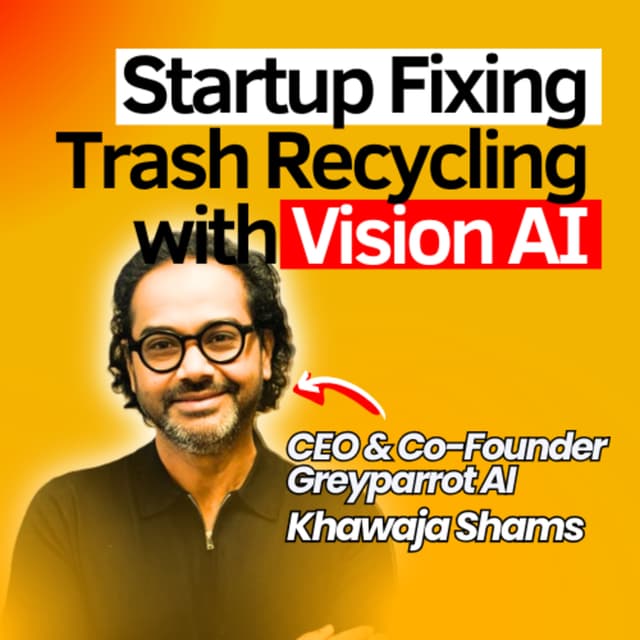
In this episode of The Startup Project, Nataraj Sindam talks with Ambarish Mitra, Co-Founder of Greyparrot. They discuss how Greyparrot uses AI and computer vision to bring efficiency to the recycling industry, the challenges of building a hardware and AI startup for harsh environments, and what it takes to power a global circular economy. This conversation provides deep insights into applying advanced technology to solve one of the world's most pressing environmental problems.
2025-06-30
Listen to this episode
AI Startup Cleaning Up a $1.6 Trillion Crisis, Building a Hardware + AI Startup, Scaling Edge AI, Digitize Waster & Reduce Landfill | Ambarish Mitra Co-Founder of Greyparrot AI | #103
VR in multiple hundreds in unit installation. I think we are roughly in around 60 or 65 plants worldwide. Uh we are in 21, 22 countries and the dominant countries in that is US and four or five countries in Europe, uh where we have density and in terms of data, I mean, and and the brain needs to work efficiently. That means our vision and deblurring of the images, lighting is this is a very dirty environment. Remember this our system vibrates. So it's it's also shaking. The whole thing is in it's basically you take the optimum world and reverse it, that's the waste world, right? Its lenses are dirty in the camera, it's it's in every way it's opposite to retail. So keeping these parameters in mind, we had to build a model which is very tolerant to this environment. Hello everyone. My guest today is Rish. Rish is the co-founder and CEO of Gray Parrot, a company that is using AI powered waste analytics to bring transparency and efficiency to recycling industry. he was previously founder and CEO of Blippar, an augmented reality and AI company. In this conversation, we'll talk about his journey from AR to AI powered waste management. challenges and opportunities in building AI solutions for recycling industry, uh and how Gray Parrot is our technology is impacting the circular economy. If this is the first time listening to the startup project, don't forget to subscribe. Uh you can also subscribe to us on Substack at startup project.substack.com. Rish, welcome to the show. Hey, good to have me here. It's so nice to meet you. So, I think let's let's get right into it. So what is Gray Parrot and how did the uh idea of Gray Parrot start? Sure. So uh Gray Parrot is a waste intelligence platform which uses computer vision based AI, blended with material sciences to recognize large scale waste flows. people when they throw away rubbish in their bins, they end up in facilities called material recovery facilities where most of the waste is processed and it's decided whether it's going to be recycled or ends up in landfill or it gets burned. And Gray Parrot uses these analyzer boxes to recognize 100% of waste flowing these plants and helps in sorting it more efficiently because it's a very large and complex problem because humans throw garbage at such a big scale that this is not a problem which can be just solved with human or mechanical interaction. It requires very large amount of vision based processing. Uh and it was almost designed or waiting for the AI era to kick into address it and we thought there's a large unaddressed opportunity, plus waste is a global crisis. It impacts lives and in terms of loss of lives and impact on planet from a carbon footprint point of view and greenhouse emissions. So we thought we'll take this address this issue head on. And was the initial idea to do what you're doing today or was it different? No, it was different in the sense that um me and my co-founder who worked basically initial founding team and some of the key early employees came from a previous company Blippar, where our mission was to build the world's first visual search engine uh and make it editable. So we built a very large model of splitting the whole world into 1692 categories. Uh it was the first time uh large scale vision model of a scale of that scale, world's biggest and largest. And uh we were quite successful at building it, but one thing we realized that our uh revenue model led to still recognizing a lot of brands which uh ended up still being in the bins and the whole pollution of it. So this got me and my co-founder thinking that actually everyone has mapped. I actually want all of you listening to reflect. Everyone has mapped the consumption world, right? Like when you're purchasing something, whether it's Amazon or through DoorDash or delivering stuff through Uber or what you're browsing on Instagram, every almost between 10, 15 platforms, everybody knows what you're about to purchase, like being so good at that prediction. Every millisecond, every last 2 meters have been mapped. But post these $23 trillion of consumption we do for annum and then things end up in the bin, almost there was no digitization beyond that bin. I call it the shadow economy, you know, the forgotten, you know, we call it waste. The word itself means no one cares. And we found that actually one of the reasons the waste remains waste because no one is doing enough digitally to value it and recover it. Uh and and that's why so much of this value is lost in landfills and in oceans. Um we we brought in deep learning. So the idea came that why don't we use our vision expertise to do something more impactful uh and more circular and bring in the concept of treat everything when you throw, you call it waste, but we we see it as paper, we see it as aluminum, we see it as different types of plastic which is also bought by these people to make this products. So we we we think of it as a material asset recovery company rather than a waste company. So um what is the actual product um that you're selling um to the companies that are in the ecosystem of recycling waste. Sure. Let me give you like a brief intro how waste works. So from the moment in typical waste advance infrastructure cities like Western Europe, America, etc, apart of Asia, where waste is collect thrown in the bins, then that bin is collected by these moving trucks, on a weekly, daily basis depends on where you live. And on the stepping trucks when they convert it back into the truck, they go away and they go to these facilities called Murf, which are called material recovery facilities. And and it's almost like a large tipping yard where large excavators pick it up and pile it on conveyor belts and then those go through layers of mechanical processes. In that, let's just call there's a large leakage in that process and a majority of those leakage ends up in landfill. So this is the problem we have to solve with how do we reduce that leakage because if we reduce that leakage, that means it won't leak into the environment, it will leak back into our society in a positive way. That's our goal. Um So we build these hardware, we call it the analyzer. The job of the Gray Parrot analyzer is to analyze in real time 100% of the waste flow. And these are rivers of waste. The belts are 2 meters wide and they're moving at 3 meters a second, you know? Some some of them in America process 1300, 1500 tons of waste per day, humongous amount. And when the camera recognizes 100% of waste flow, it helps the plant owners and plant managers understand the unit economics of the business, actually what material really comes through the business and in which one of those material is value for them. You know, what is the financial value of waste because there needs to be a business model here. Secondly, it also shows how the plant is working today. It's waste analytics. They're this whole large plant, is it an efficient plant? It's an inefficient because every percentage difference is an upside revenue uh opportunity for them. And the last thing is quality control, right? If the purity of the things coming through, one is the flow of the things coming through, secondly, the purity of the things. So how much how how much more multi stream becomes single stream. So you collect PET and it's only PET, you collect HDP, you collect aluminum because the more single stream they become, the more the buyer will pay for that purity uh when they buy it. And the last value add is some of these machines are mechanical in nature and we are integrating a brain, almost like what Wemo does to cars. You know, Wemo doesn't make cars. Wemo makes existing cars into self-driving cars. We are making these plants into semi-automated plants by applying an intelligence to existing mechanical because we send signals from one gate to another, different parts of the planet. It's going through a different loop that what's coming, you know? 100% of things come and 100% things get out and make sure there's each 10% of that 100% is as single stream and as pure as possible. Difficult to explain this over words, but I'm trying to my best to visualize it for you. So this whole thing from a plant owner and manager point of view, they see a dashboard where all these numbers are available through graph and there are things in red or green. If the plant is in green, red, they need to stop things and take actions. If things are green, the data is basically showing all the parameters it's measuring against, it's working optimally. And this whole thing works with artificial intelligence behind the scene. So uh when I was researching your product, you're basically shipping hardware and software. It is not like a traditional software company where you you access it through an app or a browser. Here you're actually shipping a hardware product with all the intelligence in it and that's sitting on the, you know, waste management belt, analyzing things and you know, computing and giving information. Um you know, typical computer vision project. What are the um architectural challenges? Or like, because, you know, sometimes when you have these offline deployments of things where you are controlling your hardware, there's always like network connectivity issues. Um, you know, waste management is not well known for its like tech savviness type. What are the like uh both architectural and sort of structural issues that are specific to this industry that you had to sort of navigate? Sure. I'm glad you asked this question because when you're a founder of a tech company, uh this was a this was this took us hard, make us think hard and go to the drawing board. This is not this is not a category where you can grow at any cost because it's a cost prohibitive industry and up to second decimal place cent matters. Unlike other growth oriented industry where it's just delivery or it's e-commerce or it's advertising, there is a correlation to your cost and the customer paying for that premium. If you're spending $5, someone will pay $10 to recover for your $5 spend. So you can have a variable cost architecture. That means when growth happens, the revenue compensates for this growth. Here, to keep to mind, but if my costs keep going high with growth of our business, the revenue will not proportionately grow because no one's paying waste for volume because that will incentivize because it's not a positive thing here, right? No. Here, we have to recover more waste, you know, and we have to create value out of it. So and the the and the tonnages are so large, you know, it's billions and billions of products. So we had to build an architecture where a lot happens locally. That means when we are deep learning and the CNNs are sitting locally in the machine and classifications are happening, my costs are not going up as I process hundreds of millions of images. We actually process images sometimes at the scale of social networks. So except you're not processing people images, but we're processing trash images and it's continuous and it's large. Secondly, is it needs to be real time, really near, the best word to call it, NRR, near real time because it's it's a 30 millisecond engine. It's almost flickering like a speed of the eye. And everything that's being recorded, it's not just being recorded. It needs to give a reaction time in real time to the next machine for a robotic arm to pick up or an optical sorter to eject or, you know, or the plant to stop because, you know, there are some hazardous materials, various things or control the belt speed. So there are several parameters. Keeping that in mind, this this system cannot uh rely alone on a website connect sorry, a web or internet connectivity because if that goes down, then it'll stop working for the plant. So it needed to be. So keeping these parameters in mind, we came up with an architecture which requires the internet, but periodically a lot of the stuff is on the edge. A huge amount of it sometimes we over simplify it by calling we are CNN and deep planning company. No, huge amount of vision stuff happens actually on the camera. How do we process the images, normalize it because the lighting conditions in every plant is different. So I'm not making a custom product for each plant. I made one platform which works in every plant, right? That's how it's a scalable business and I'm trying to sell our analyzer like a commodity. When you have that vision, your your model architecture and your hardware both have to go hand in hand and you need to plan this upfront because we need to keep our cost of goods low and we need to we need to keep our overall customer maintenance cost low. So uh it it it was an interesting challenge where from all the all the way of how we capture images, deduplicate it, normalize it, then learn it, then the build the model around it and which then works with 99% efficiency continuously all the time 24/7 processing hundreds of billions of images annually and that number will go into trillions next year. Uh it needed us to rethink and it needed us to challenge conventional thinking, which in a way, combine it with COVID because we were sort of a fresh post-COVID company uh where we couldn't visit plants and we had to build the product and ship it, how how portable the system is. It's not something very big. It's like literally size of one and a half times overhead projector. Uh many of these things needed to be considered and I I think we are all very proud of it because our analyzer product is up to 30, 40% even made of recyclable goods so that we live up to our values. So yeah, I can I can go on about this, but there were a lot of lot of aspects of it. real Can you expand on Can you expand on what do you mean by, you know, how your computer is happening via camera? Like what does that mean? Sorry, I I didn't get. While the computer is happening? You You mentioned you're not you're processing in camera. Yes. So so we have uh a GPU CPU depends on the version of the uh hardware, multiple we have five versions of our hardware. Three are always deployed in the market. And we first of all came up with an architecture where our software was not dependent on our hardware. You know, earlier we were too tried tied to one brand of GPU. Then we realized post COVID when we had the whole global GPU shortage, you know, and and chip shortage. Which GPU were you using? We were using Nvidia, you know, without going to specifics of the model. And and then we were we actually made it so light that it could run on CPU. You know, and CPU is what available in the market. To an extent like very startup style, we went and bought it from second-hand market in large supplies because no one wanted CPUs. Everybody wanted uh GPUs. But decoupling the software with the hardware uh was one key uh decision. Another key decision was we wanted to power other mechanical devices, including people when people think of robotics is smart stuff, but robot robotics is just an arm and the efficiency of a robotic is twofold. One is as a mechanical device, how frictionless it can be. Like if something works like this 5 billion times and the motors fail and that's the real competency. That that's the robotic company needs to focus on. We didn't build a robotic company. We build an intelligence business. So our goal is that robotic companies every time it sees the thing it needs to see, it picks up accurately, all right? If the gripper is not working, that's a failure of the robotic company. If the motor is tied, it's a failure of the robotic company, but if it's not recognizing something, that's responsibility. So we realized that we keep focusing on the brain and and the brain needs to work efficiently. That means our vision and deblurring of the images, lighting is this is a very dirty environment and remember this our system vibrates. So it's shake it's also shaking. The whole thing is in it's basically you take the optimum world and reverse it, that's the waste world, right? It lenses are dirty in the camera, it's it's in every way it's opposite to retail. So keeping these parameters in mind, we had to build a model which is very tolerant to this environment from a processing point of view, but also from a capturing point of view. That means we can take a dirty data and normalize it from our environment, which requires a lot of local processing. So I would say like 60, 70% of our secret sauce is on the hardware device and 40% of it is on the cloud for post processing uh purposes and further mining it for intelligence and extraction. But the primary goal of our customers in real time because you have to also split this architecture that you don't need all informations real time because there's no value to the customer. The real time information is coordinates, where the object is, optimal pick point, average weighted where where do you pick a plastic bottle is very different to where you pick up a cardboard box, right? As a human you'll also react differently. And then of course our what material is it made of? Because that material has an immediate value where it'll go to. But then on other things we are extracting from brand recognition and carbon footprint and many other layers of information which we mind from the same data, which we do as a post processing thing from the cloud. Do you um do do like brands uh get intelligence from you in terms of like how much of you know, their stuff is being you know, recycled properly versus uh not properly? Like is that something some day other brands come to you? There is a lot of curiosity in this area. We are working on a product proposition along this lines and we have some very exciting announcements in the middle of the year on these lines. Yeah. But there is a need there is there is a let's just say there is a need for this in the market because uh not for any regulatory framework purposes, but purely the world of brand spends in magnitude of billions of dollars in packaging R&D. Something that will come out in four years is being designed today because they have supply chain commitments to, right? Because hundreds of billions units of SKUs are planned by mega brands. And uh the Gray Parrot waste intelligence can really help with getting a lot of real time insights because what we reflect is the real world and sometimes what they do is in their test centers, but that's not reflect of the real world, you know, because something to learn is no two waste management plants are same and waste pickup, waste sorting varies from country to country where brands make the same product for almost every country from a packaging perspective. So there's a lot to learn and share for basically to improve circular economy in general and helping them with that, uh we see an interesting opportunity. Can you talk a little bit about, you know, customer acquisition? Like how how did you approach your uh first five to 10 customers? Like what was that journey like and then how did how do you scale now in terms of like approaching your customers? And I think you also have like interesting way to partner with um you know, create partnerships in the industry. can you talk a little bit about that as well? Sure. So, like any um disruptor and an outsider, that's why we are a disruptor. You have to learn the hard way, uh and and and interesting thing is we come from a background of large scale vision based compute and deep planning and we could have applied this technology to any industry, but we chose this one. You know, the team was good enough, uh one of the best teams in the world in this category, but we didn't understand waste. So we really in the first days, we did something different and smart. I like to believe that we actually build the version one of the product with the waste industry. We we were not like uh arrogant to say that hey, our algorithms can recognize waste, here it is, go find value in it. No, uh because first it had to be showed that there is value in analyzing and there's some interesting outcomes. So we first and asked these these waste management company that what problem they're trying to solve? There's the problem of counting because there's a very high there's some government requirements for them to keep up with 1%, 2% different audit trails and it was very manual and intensive, which could be automated with us and then there's an element of quality control. So we learned all of that and we released our first version of the product by talking to seven, eight customers and literally we were giving them that whole intelligence for free, learning from them and sharing that insight for first two years while we build our mega model. One thing we we also did differently, we didn't make it in one geography. So we were quite spread through various serendipity and we intended to be spread and we succeeded. We had some exposure in Europe, some in Britain, some in America and also in Far East in South Korea to get diversity of data because waste is different looking uh and treated differently in different parts of the world. So model needed to be tolerant, the first model, okay? And the first model only had 11 to 12 level of classification by literally calling something plastic, paper, cardboard, back to basics. Literally how a kids learn, right? And We don't need to go into advanced classification. Because you can take those very variance and then split it down further down the sea CNN. Uh so then we realized slowly as the model got better and we our product came out and people started to see the value and the word started spreading, uh to answer your question as you asked me before, like commercially, we were like any startup, we were a direct model. We hired very good sales people from the industry who know the industry. We would because we felt that we are tech guys, but we need the commercial acumen how to sell into this industry. And then we learned that actually there is a whole middle tier in this industry where you have specialized sales people who are in a way plant builders and the plant builders are already aggregating multiple technologies to build a plant, right? Because they're building other scanner than and we need we needed to see it us as a component based value add. You know, and what we were trying to do is almost force ourselves into it, right? Like where it needs to be it it it needs to be like diagnostics. We are diagnostics, right? And so if someone is building the plant, they need to check the efficiency of the plant, not manually real time all the time. So it really met sense to the plant building community and in the last two years, we partnered with uh Bolograph, which is the world's biggest plant builder. Um they have built thousands of plants in the world with like 20, 30% if not more global market share. And then we also partnered with Van Dijk recycling solutions in the US, which is America's largest plant builder and I think they've build 275 plants out of, I don't know, 400 plants in US significantly share who who understand this market well, understands our clients well. Disintermediating a direct sales model through strategic partnerships for markets where people have deep knowledge in that market and deep relationship and we continuously support them with training and we we we became a grown up company. So instead of retaining all the knowledge within few sales people, we made that into a uh a customer support portal and a training portal which a customer can help themselves or the intermediaries can help themselves and log in and it's like a massive database of any question you can ask connected to installing waste intelligence, full support system which typically quite a few grown up companies would do at our stage. Uh we felt we scaled our business and we matured it differently, which also made made us a lot more cost efficient because sales can be a very expensive thing as a part of international growth story. We would rather give margin to our partners uh and we found better success at it at least this stage of the business than going direct. What is the scale of the business? Like how many plants are you supporting today? How much data you processing and how much waste are you saving? So we are in multiple hundreds in units installation. I think we are roughly in around 60 or 65 plants worldwide. Uh we are in 21, 22 countries and the dominant countries in that is US and four or five countries in Europe, uh where we have density. And in terms of data, I mean in pure pure objects we processed around 50 billion objects last year in 24, but in in in pure I don't know, bounding boxes, that number was in hundreds of billions, you know, of of information the infrastructure was processing. But we've architected the business to really scale. So if this number was, I don't know, like few trillion objects and if today we have a sales velocity of that we have to do on all of US market or European market, we already in a position. We've looked at our supply chain. We design, create and manufacture our product in Britain, which is a rare combination. Uh last two years we brought it home. We launched a very sustainable, very cool GP5, which is a new version of hardware uh along with a new version of software. So um and also you guys need to check it out or search it. It's it's very cool. You know, as if we're launching a Apple like product in the waste industry. when you look at like different markets, you've obviously seen uh multiple geographies from east to west. I I mean I think you grew up in India. I grew up in India. In that part of the world waste like the waste uh processing is still in a nascent stage. Can can you give a like sense of how fast or slow things are moving across the world or just like in the developed countries where there's lot more emphasis on the circular economy versus, you know, countries like India, you know, where I I at least personally, I'm not aware of that much, you know, new type of stuff happening. So what's your sense of like what's happening in the industry? So I have to go a little philosophical on this just because of my nature of bringing of bringing I grew up in rural India and I'm not a city person, but I've had a journey in my life which brought me from rural India to cities, then cities to the West and I've lived in America, UK, different parts of the world. And I feel really in the modern waste issue is a city issue. City has population. Cities have consumption choices. Cities have a lot of packaging, you know? So, so when we talking about developing or developed economies uh and looked at the countries like India and other parts of the world where this large population, the cities and the rural parts are behaving differently. And the cities are different behaving consistently as rest of the world and the rural parts of India strangely is naturally circular by their choices, you know, you know, and and by their packaging design and there's less infiltration of certain types. Of course, you have your cris packets, which is some kind of flexible and stuff which are very hard to recycle, uh which have made into all parts of the society. But they have natural circularity models of there'll be a man and a woman who'll buy in exchange of clothes or dishes, like you all your plastic bottles and a lot of barter systems in these economies and there's really intrinsic value in collecting things and people don't like to waste. But for AI, where this this is an interesting thought to connect with our business model. AI fundamentally today in simplest in anything whether it's large language, it's an efficiency play. That means there needs to be some level of organized infrastructure to make it better. It it's not like it is not like creating something completely new from non-existence. So if there is not a organized waste pickup and waste dump structure, then there then it's very difficult to bring in AI. You know, uh because there isn't a process which you can relook at and then make it many folds better. Uh and a lot of the waste is collected in hand and then dropped somewhere else in hand and then sorted for valuable materials rather than disposal of waste. So the waste rots, people go and individually mine for certain kind of bottles, certain kind of clothes which happens and then that whole dump or mountain of waste even outside Delhi, it just rots and creates fumes which is heavily toxic for the society. In fact I uh it is the breaking news like even seven days ago, Gurgaon, which is just suburbs of Delhi had one of the worst pollution days, well above normal because a waste dump got fire and there was a whole smoke around the city. Uh and and AI can really solve this, but only when municipality and government can introduce some level of organized waste pickup structure and I like to believe there's enough incentive in the society in the waste business itself to make money because there's a lot of value and demand for these materials in the second-hand market particularly when the world of brands have uh pledged large amount of uh budgets towards making all their packaging sustainable by 2030 kind of deadlines. That means they need to rely on supply of you know, recycled materials rather than virgin plastic. But at the same time, the price of oil going down takes some of these incentives away and virgin plastic is so low and you know economies are one way or other still connected to oils and I can digress but that takes you to a whole different conversation. China, like I mean China from what I see, uh they're quite I mean in a turnaround path when it comes to like pollution in general. Um and I think a couple of years back we saw that Beijing is full over covered with smoke and the stats show that it's sort of in a downward trend and they're doing a lot of things uh to sort of make those cities better. But do you have a sense of like how their waste management systems are? I'm sure they're looking into it. It's very of course China is very difficult to look through, you know, as a glass. There's lot of layers and then of course there's an element of what they want, how much they want to show you versus what's happening. Uh one thing positive for China is decision making is very centralized. So if the government decides to take a path, things really get done, you know? So if they in if they invest in waste management, then uh they'll handle it. I mean China uh six years ago or seven years ago, closed doors to process world's waste. They used to process entire America's and Europe's waste and many other countries and that's what made waste a local problem and waste become a bigger issue in the waste because China used to take care of it. Whatever take care of it meant, but it used to take care of it. Uh and now they are they introducing their own waste infrastructure to do things. I don't know how much automation they're bringing in, but I would I'd like to believe they are, you know? And and and and and I think they are they had poor environment and credentials, but in all parameters they from solar to other areas, when they take a turn, they go from one end to another and do do a good job with it. And the the turnaround time is pretty quick, like you can see the impact in maybe three years, two to three years, you can see a quick turnaround in all the graphs. Um for the when China stopped closing the waste management or taking the waste from outside countries, where where did it get diverted to? I know that it's diverted to lots of Asian countries. Yeah, Malaysia. Malaysia, Thailand, Cambodia, you know, a lot of electronics waste goes to Africa. You know, so there's categories where plastic goes somewhere else, clothes go somewhere else, electronics go uh somewhere else. So uh and and then when they go, they they're reported as recycled, but they're not being recycled. They're being burned or disposed and and from a planetary perspective it may not be one country's problem, but from our earth it remains a problem and it has a big impact on our uh our greenhouse emissions. But but we have enough materials in the world today in circulation to make everything all over again and again and again. We really don't need to dig more holes in this planet to build things. There's enough floating. It's the same way like we have enough clothes for next six generations of human population to have enough clothes right now in the economy, but still another guess how many? 100 billion units of clothes is going to be manufactured in next 24 in 12 months. That's the sort of side effects or second order effect of consumerism. You know, we got fast fashion with brands like Zara and Yeah, but the thing is that consumerism uh that's a that's anthropological and social angle and it's like steering a ship. You cannot change the direction fast. Can we but at least from a production side, if the materials used are the same because those materials exist today and if they're reused and repurposed and it if it becomes a more trendy thing and if brands lead the stories bigger to smaller where that is the thing to do, uh it'll make a it'll make a big difference rather than keep keep throwing new stuff with brand new materials and polymers because again, even though we think clothes are cotton, most clothes have plastic based polymer. Everything's plastic. So that means everything's oil. So that means everything's being mined uh fresh and we we need to be a little more conscious of that. Which countries do between the best versus? I don't know, what are some of the worst. I think that's that would be a long list but like have you like seen like these countries do better than most other countries? Yeah, I mean I would say Japan and Korea are very good. Germany is very good, you know, and uh society is very conscious. They have um designs of um the society is designed to collect waste in many forms rather than just from your bins, you know? Like Germany has something called direct uh deposit scheme where people can go put bottles and straight into and they get some vouchers against it and you know, and and many countries have these milk bottles which get collected and stored and nothing is in plastic and um so I I and I would say it's a it's a triage. There's no whose responsibility is a hard one. I would say there's a triage. The four, there's four components. Uh one is the manufacturer and if the manufacturer can take a little more responsibility and it's a hard one as a tradeoff between market. Marketing is what's creates colors and differentiation and non-standardization, right? Every whiskey bottle, every drink bottle wants to look different because that's how your eye catches it. But if you standardize it, like a USB is, right? Like imagine if all cables were different in the person. That means there's reusability, right? We can all borrow each other's charges today because the standardization. So bottles can be standardized. They're a very large part of the product chain. Then you have government's role which can put a little bit of stick, not carrots in this that force their hand in a bit in these decisions. Then you have the waste management side which can optimize more, work, introduce AI, digitize. And the last quadrant, which is has a lot of power but often doesn't use it as the consumer, making choices which are more circular in nature. That means there's an economic incentive for the brands to go down that path because consumers is making their choice stated and heard very clearly. That all the four need to needs to almost run like a perfect movement and I feel today consumers are making some choices. Governments is doing something and few brands are doing few thing in for a fragments and a perfect storm hasn't happened yet. I think uh we're almost out of our time and I think that's a good place to end the conversation as well. Um thanks for coming on the show and and looking forward what Gray Parrot will uh great Parrot's impact on the recycling economy. Thank you for having me. I really enjoyed it.
Listen on Spotify | Apple Podcasts Subscribe to our newsletter More at thestartupproject.io