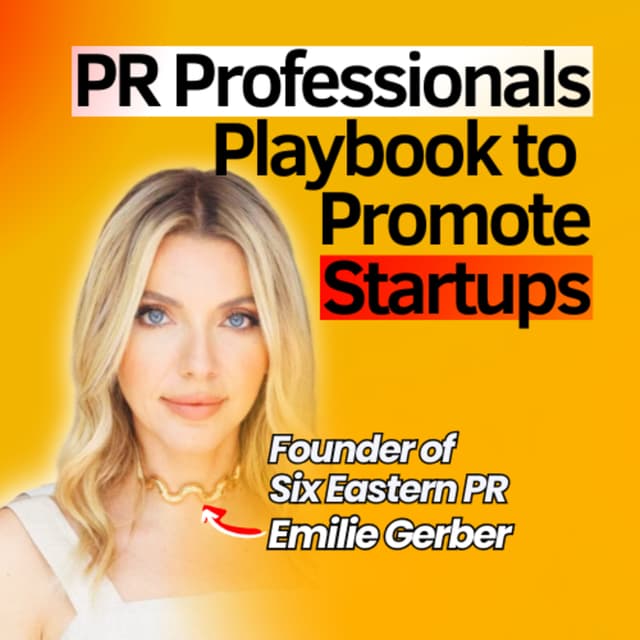
Transcript: The Unfiltered Playbook to Make Early‑Stage Startups Get Media Traction & Demystifying Public Relations for Tech Founders | Emilie Gerber Founder of Six Eastern PR
In this episode of The Startup Project, host Nataraj Sindam interviews Emilie Gerber, Founder of Six Eastern PR. They discuss the unfiltered playbook for early-stage startups to get media traction, demystifying public relations for tech founders. Emilie shares actionable advice on pitching, storytelling, and knowing when to invest in PR, drawing from her experience with companies like Uber, Box, and Ramp. This conversation is a must-listen for any founder looking to build their company's reputation.
2025-05-05
Listen to this episode
The Unfiltered Playbook to Make Early‑Stage Startups Get Media Traction & Demystifying Public Relations for Tech Founders | Emilie Gerber Founder of Six Eastern PR
Nataraj: when we worked with Ramp in their very early days, they launched um, a bill pay product.
Product news is something that reporters generally are not interested in covering, but at the time Bill.com I think was one of the best performing, uh, stocks, um, and doing really well.
But the angle that we took, we went to CNBC, which really only cares about public market companies and basically pitched it as like this, you know, hot fintech startup is taking on Bill.com with their new offering that also happens to be free, whereas Bill.com is paid.
Um, and they they CNBC loved that angle. They ended up covering it. They did a great story on it. Um, and then the next day I think Bill.com stock was down a little bit.
And so one of the news aggregator sites like compared the two like Ramp launched this and now Bill Bill's stock is down. So that's like a creative example of being scrappy.
Nataraj: I don't know if it's Elon effect or every founder sort of wants to be direct and tries to be a persona on Twitter. Is that where the PR industry is going?
Nataraj: So this, I mean it is the general sentiment is yes, you should be doing this. I just personally, maybe this is a contrarian view.
I just don't know that it's going to be possible for every founder to build up a huge social following where it's actually worth the time investment in the first place because we're not all just going to be following a thousand founders on X and paying attention to every LinkedIn post that they do.
And so, I I I just I don't know if it's always realistic.
Nataraj: My guest today is Emily Gerber. She's the founder and principal of Six Eastern, a PR firm for startups and tech companies.
She was previously corporate communications at Uber, did product communications at Box, and was an account executive at Blanc and Otis. In this conversation, we'll talk about effective PR strategies for early stage startups.
What is the evolving landscape of media relations in tech industry, and tips for securing impactful media coverage. Uh, if this is the first time listening to Startup Project, don't forget to subscribe to us wherever you listen to the podcast.
Nataraj: Emily, welcome to the show.
Emilie: Thank you, it's great to be here.
Nataraj: Uh, so I think a lot of my audience is, you know, tech heavy. Um, you know, people who work in tech or try trying to start companies, founders, operators, and they're usually unaware of um, the PR industry.
Um, I think a good place to start for us is if you can set a context about what actually, you know, a PR company or a person does in general and then we can sort of narrow down it to tech in specific.
Emilie: Yeah. So I think the the biggest misconception I see, um, when chatting with founders, um, especially first time founders that haven't necessarily done PR before, is kind of conflating marketing and public relations.
Um, so marketing involves a lot of, you know, paid methods. You could do, um, you know, paid advertising, um, sponsorships, that sort of thing.
There's also the own content, stuff that you post on your blog, doing webinars, um, the social channels that you post to. So, PR is really neither of those things.
There's obviously always going to be a little bit of overlap, but PR is anything that's earned media.
So earned is when you are able to, you know, get that speaking slot or get that interview with a reporter, um, or get on a podcast without necessarily needing to to sponsor or pay. You're getting it because of your credibility.
Um, and so the the value in that is that because you're not paying, there's supposed to be this sort of objectivity to it, um, where you earned the spot because of your credibility or the business you're building or what you have to share with the reporter.
And so it's kind of held in a different regard than other kinds of marketing.
Um, and it's an important part of the puzzle, but the thing is for startups because they're usually small and new, the there's not going to be the same sort of, uh, interest necessarily in the business as what as the companies that are further along.
And so, I think the other big misconception is that, you know, you launched your company now let's go get that big Techcrunch feature or that big Wall Street Journal feature.
Um, and most of those publications have maybe one or two relevant reporters to your business and they're in in charge of covering your entire space. Um, so that's not always uh necessarily what you can get right off the bat.
Um and there's other things that we can go into that you can get, but I think that's usually what I find from the the first conversation.
Nataraj: At what point in a startup stage, um, is it worth, you know, having an internal or an external PR, um, engagement.
Emilie: Yeah, great question. Um, I would say for a lot of seed stage companies, it does not make sense to have a PR agency on retainer. There are exceptions to that rule.
We're working with a seed stage company right now that is doing some really wild stuff. They have an AI tool being used for a class at Harvard Business Review and every student's taking that course.
And to me, you know, that's that's a big enough story where it doesn't matter that they how much funding they have, reporters are going to be interested regardless.
But if you're building like a more infrastructure AI tool or software, um, chances are unless there's something that's really, really unique and the bar for unique is super high. You don't need to have an agency on retainer yet.
Um, what you can do is you can potentially still make like a one-off announcement announcing that the business exists and that you've raised funding, um, especially if you have, you know, a relatively large seed round or some great investors.
Um, you just have to kind of be more realistic with what you're going to get for that piece. And so generally speaking, you know, when we work with with a company that's early, we're trying a lot of different things.
We're being really creative with the outlets we go after and we will get something.
Um, but you just can't you shouldn't bring on a PR agency if you're expecting, you know, a really top tier piece of coverage in the Wall Street Journal because that's not that's not realistic.
Um, but yeah, in a project capacity, seed stage companies can do something, but I wouldn't have someone on retainer. Um, I think by the time you're series A, there's there's more that can be done and it can make sense.
Um, I think there's some really great consultants out there too. You don't necessarily need to bring on a full-fledged agency. We're kind of sit in the middle where we act a little bit more like consultants, but we are an agency.
Um, but by then, you know, you're still not going to be getting the huge stories, but there's going to be, you know, podcasts to go on. That's how we originally connected was through some of our clients that went on your show.
They're going to be awards and lists you can submit to like just yesterday Forbes AI 50 came out. We had two or three clients on that list. Um, there's going to be speaking opportunities at conferences.
We have a bunch of clients going to the MIT AI conference next week. And so there's going to be stuff that you can be doing, um, and find value out of the engagement.
But really the longer you wait, I think the more the more you can end up doing and you're going to get higher ROI from the engagement. Um, so even then, you know, some companies wait till they're like closer to series B, I would say.
Nataraj: I think the seed stage phenomenon is probably unique to AI startups and this is recent phenomena, right? Because I think Mira Murati was raising a two billion seed round, which is which is which would probably be an IPO five years back.
Emilie: Oh my gosh. Yeah and and um I think that's definitely true. We work with some companies that are technically seed stage but have raised amounts that are closer to what you'd hear for series A or series B.
Um, and so the whole stage, I think terminology doesn't work in the same way it used to. It's almost better to talk in dollars and cents because at least then you're talking about something more tangible than just stage.
Nataraj: Um, in terms of like just the landscape of PR for startups, who are like the top tier firms uh that the OPAIs and Anthropic are working with.
Emilie: Oh interesting. No, I think they're very hush hush about who they work with. But um, yeah, so I think there's a couple of buckets of firms out there.
There's the large incumbent firms that have been around a really long time like the Edelmans of the world, and even I think Outcast agency is one that's a little more modern but has been around a while.
Um, and so there are many companies that work with them.
I think the ones that find the most value out of it are big global brands that have large in-house comms teams and need a lot in terms of like not just media relations, but stuff like tracking and reporting and sentiment and Trustbarometers, which I think is like an Edelman term.
And so, uh, I think there there's definitely still a place for those firms, but when earlier kind of companies that are hoping to move faster, um, uh engage like they're not going to, well first of all, it's probably out of their budget in the first place, but it's just not the right kind of model for what they're looking for and I think they'll be the first to admit that.
Um, and then there's like more mid-sized firms, um, like um, Strange Brew strategies, I think Mission North is one of them.
Um, ones that have like 50 plus employees and I think a lot of um, a lot of tech brands will work with them and they can and they still do a lot of media relations too, which is a big thing we're starting to see is companies move away from just doing media relations or firms moving away from media relations and trying to sell like larger packages of like content um and other services because of how hard PR is getting.
So like I'm always on the lookout for firms that'll still do just PR. I think those are the ones that will. Um, definitely Strange Brew.
And then we're like a little bit smaller than that um and I I think we work with our fair share of top top AI companies as well.
Um, and I think where our real sweet spot is is for those companies that are hoping to like move really, really quickly, just focus on media. I think we act like a startup.
We do very little in the way of like huge plans and tracking and reporting and we love to just get out there and pitch and like, you know, with most new clients, we're pitching our first week and that's not a fit for everyone, but for a lot of startups, I think they find that very appealing.
Um, so yeah, that's something in our DNA that I'm hoping to preserve even as we grow.
Nataraj: I think one of the metrics, I mean externally I see is, you know, when you hire a PR form is, you know, you talked about, you know, getting into Techcrunch, getting into, you know, high profile events as a speaker.
Um, and you can name those and when you see those, you know that something is working, right?
Um, how do you you know, sort of cater the expectations because every startup will see, you know, your previous success story and um then come to you that, hey, I also want when I raise my CDSA a Techcrunch coverage or Wall Street Coverage.
Like how do you gaze or like set those expectations with the company that hires you.
Emilie: Yeah. So I try to really dig into the details with them of their story versus what they're, you know, comparing themselves to.
And maybe they are the same caliber and maybe we can go pitch something that's similar to something else we landed for another client. Um, even when we are able to do that, it often just comes down to reporter bandwidth. So I explain that.
Sometimes you could have the coolest story in the world, but if it's happening at the wrong time or you just have bad luck with pitching it, part of it's luck, um, then you might not get the same wins.
So the first thing I try to do is emphasize how much of it is not in our control.
Um, and another thing to emphasize is that reporters are not, we're not paying them, they're not getting they their only job is to report on the news and to tell stories they think that their audience will find interesting.
And so they they don't owe us anything. They don't owe the startups that they cover anything. So I try to emphasize that as well.
Um, and then if the story if they're comparing themselves to like kind of a unicorn story then it's not similar to to what we're telling for them. I I try to like go into the details.
Well this company shared that they just reached uh 100 million in ARR or this company has celebrity investors. Like what are we bringing to the table that's similar? So if it's an outlier, I try to compare.
Um, and then another thing that I find that founders love to do is find the one exception, like the one time. Um, like like uh I was talking about this for for Lenny's podcast.
He had one CEO on that didn't fit his normal criteria for what he's looking for. And then every every client sending me, see, he did do a CEO interview that looked like this. Um, and so exceptions happen and I try to explain that as well.
Um, but it's definitely, I think it's it's a balance because you also don't want to be shooting, you know, you're a founder of a company, you're super excited about what you're building and oftentimes it is really cool or really novel.
Um, so it's a balance of showing them that we're equally excited and that we're going to try to get them the best possible outcome and that they're in the best possible hands to get that outcome.
Um, but it's just a it's a tough world out there with media. That's such a good question, I love that.
Um, so first I think something we do really well that maybe um, needs to be like recognized more broadly is the way you pitch a podcast should be so different from how you pitch a traditional journalist, um, for many reasons.
Most podcast hosts have a very specific niche that they want to focus on and we learn that more the more we work with a certain host.
So you know, I'm getting better insight into the kind of guests that you like to have on and that happens with a lot of different hosts. But it's not about just what's the biggest name we can get them a lot of times.
Like they are looking to it's a conversation. So the name helps a little, but it's not the whole thing.
Um, and so I think with podcast pitching, we try to be very direct and conversational to the point and focus on not just the person's credentials, but what they can talk about on the show. Um, and really pattern match that to the specific opportunity.
Like if we're doing our jobs really right, we're actually looking at several past episodes, seeing trends and then figuring out guests from there.
You know, in a perfect world we do that really deeply every single time, which isn't possible, but you can do some level of pattern matching even just by looking at titles or a little abstract that's below.
Um, and then this is like more of a hack and I think founders can do this as well. I love just DMing on LinkedIn as well.
I think that's how we first got connected and still are connected, but it's so nice because you can just send these short little pitches, ask if you're open to guests. If they say yes, come up with your best ideas for them and then go from there.
And it's just more conversational and casual and everyone's on like LinkedIn. And so I really like doing that and that's something of a founder decides they want to be on a handful of podcasts.
You can spend an hour, do some research, figure out what those are, send them a note, here's why I'm relevant and here's what I can talk about and chances are one will reply. Um, so that's podcast. Media is very different.
I think, um, if you're trying to pitch Wall Street Journal, they are going to care about traction in the business and things that like show that they're they're they're not able to do their own due diligence on why you're important.
You need to kind of give them that information. Um, and then relevance either to a specific story that you know they're working on, which sometimes we can get word of based on stuff they post on social or something else or like why? Like the why.
Pitching them on news, are we pitching them on an intro conversation? And if you are pitching them on an intro, like why should they take the time for this intro? Like is it going to be relevant to something they're covering in the future?
So it's a little more precise and I think the things that you lean into tend to be different.
Um, but I guess the thing that's similar is we love the like direct to the point not salesy tone because it's just I think the reporters are really allergic to like we're the most innovative platform, revolutionizing the XYZ.
And like I'm sure you are as well. But like no one wants to hear that. And I'm sure you get pitches as well where you're like, this is not something I would be interested in.
Nataraj: I think there is also, you know, we we see all this advice about, you know, the pitch has to be simple, uh, you know, it has to be direct, it shouldn't be salesy, but all you see is salesy pitches.
And you can pretty much see the format everyone is following that they'll take the latest episode, uh, publish on your feed and it's included in your top paragraph, uh, with the same blurb of your guest and, you know, it it's feels very automated and, you know, you can almost see like okay, they've automated this into.
You put a LinkedIn profile here and my guest profile and there is some matching and it's creating an auto blurb with AI and they're hitting send and sometimes they often mistake the name of the podcast or um you know, name of the guest uh that they've recently listened on the podcast.
So you can clearly see that it's all automated and they've not done the research on uh what the podcast actually wants. And even though it's like sounds very simple.
Emilie: Yeah. That's something.
Emilie: I think you know, I haven't used any and I'm not interested in using any.
I think there are some software tools that are popping up that will like guarantee to get you podcast guests locked in, um, or for your spokes people and that's exactly what they do is they create a template message and then they plug in the rest.
And it's funny because I even think the general template message before adding in all the weird like custom intro, that part's even bad.
So it's like if you at least need to draft like a good at least if you have a good foundation message, then maybe the other part can be forgiven a little bit.
But I think I I hate those tools because it just makes our notes get buried and we don't and we I'd rather have one really good podcast fit pitch and send it to 10 relevant folks than rather than blasting like a hundred um with some like weird semi custom thing.
Um, but like and you can it's a fine line because you can make actual custom intros that like you can still say like I love this episode, but one topic that didn't get included in it that my guest could talk about is XYZ or like I disagree with this take that you recently had about XYZ.
And that's like an authentic intro because it showed at least a layer deeper of like understanding. Um, but yeah, I hate that all these uh automated ones are kind of getting in the way of that.
Nataraj: And over last 6 to 12 months, what I realized is there's a huge gap in like um the OpenAI of the world and then there are so many companies which are at series A to series C stage which have no coverage, which are really good companies, there's no storytelling really happening.
I see that that's a really, really big market and everyone wants to be on the same five podcasts or same five uh you know, newsletters and there's a huge competition while there's this middle, which is really, really, really big in tech.
And probably your approach to PR is actually, you know, capturing those companies and you know, how do you do a better storytelling for them.
For podcasts specifically, do you advise founders to sort of, you know, craft the message, like do you help crafting their message uh because often like things can look really great on paper, but having that a lot of conversations, not every great founder is a great storyteller.
Emilie: Yeah, totally.
I it's it's a fine line with this as well because I actually think a lot of the larger agencies spend so much effort crafting messages that it's like the execution piece gets lost and they're not even focused on pitching and they kind of, I think it's easy for founders to get too in their head if they're like going off of talking points.
I think those can actually be more valuable for traditional media interviews where you really do want to land the headline and we really do want to land like one or two specific quotes in. For podcasts, I don't know.
I'm a fan of going at it a little more casual. Like if we can get the questions in advance, which some podcasts do share, some don't.
Um, that can be useful for like, hey, look these over, see if there's any that you think are alarming or you want to discuss with us or you're not sure how you'd answer and let's go and focus on those.
Um, but because it's not really a product pitch most of the time, it's like talking about their journey and their story.
Um, I I I prefer they usually don't spend too much time um on specific talking points because they usually just end up sending really canned or out of place.
Um, one thing that can be really great though for prepping for podcasts is having like a couple of stories or anecdotes in your back pocket that you always just use and have there. Um, and those can be useful to think of in advance.
Otherwise you might just not they might not occur to you on the spot. So I love that. I love having like, here's a story that I love telling or a couple. Um, and then just pulling those out when when they're.
Nataraj: Yeah, the advice I give all my founders before we start recording, you know, usually we have a call a couple of weeks before and I always tell them to start a document to note down their thoughts or like the highlights that they want to make.
Um, and it's sort of like the strategy a lot of, you know, thought leaders have. Um, like you have ready to go points repeatedly refined again and again.
So you and I share them with the doc and they're always, I I tell them you can use this as a starting doc for future interviews and you post your viral ideas here.
Um, because people often see, you know, successful thought leaders and they think it's coming off of the hip on a podcast.
It's not, you know, they have this running notes of ideas and sometimes editors and a team of people, you know, bringing interesting statistics. Um, and combining that weekly into a narrative that they believe in and reinforce and, right?
So that's a strategy that's happening for a lot of thought leaders and I try to give that playbook out to a lot of technical founders who are not doing it even though they have good ideas.
It might come out as tweets, but they're not actually being captured in conversations even though they might feel like, oh, I didn't I forgot to mention this idea or I didn't bring up this idea.
But it it has to be a little bit more conscious than, you know, just, you know, going uh like like okay, let's go shoot the shit, right?
Emilie: Yeah, yeah. That's why I like the stories as well.
And a good point you raised too that I that I forgot is having in your back pocket like the stats that you can share or like whether it's like the customer names that you're able to disclose and maybe some of their stories, like the latest stats on the business that you're comfortable sharing any market or industry stuff, like those are not going to be top of mind for you unless you have them prepped in advance and if you're at a startup, you do want to make sure you're being consistent with what you're sharing each time and you're not just going riffing with the the the company metrics.
Um, and so yeah, that's another area where I think it can be really useful to have something written down in advance.
Nataraj: I think there's also this whole trend of like founders going direct and um, you know, not engaging.
I I think if if you go five years back, like when Uber was the hottest company, like there's the whole PR filtered between companies and what the founders of the companies communicated.
But now I think I don't know if it's Elon effect or um, you know, every founder sort of uh, you know, wants to be direct and uh tries to, you know, be a persona on Twitter. Like is that the is that where the PR industry is going?
Um, like are your founders thinking about doing that? Is that the advisable strategy that you tell your founders or what what's the how do you look at that trend?
Emilie: Yeah, it's funny you brought that up. We're actually currently doing a survey of startup founders and folks on their team that run marketing. And we, one of the questions, I think we have about 60 respondents so far.
So 60 different startups have replied from series A through series actually, I think seed through series C for the most part. Um, some some larger companies as well.
And I think 96% put that it's important to build up your founder's social profiles, which is actually just like even way higher than I expected. Um, and so this, I mean it is the general sentiment is yes, you should be doing this.
I just personally, maybe this is a contrarian view, but I just don't think it's realistic or scalable for that to be the case. Not every founder, first of all, for not every founder it's going to be something that comes naturally to them.
Um, and some it's going to take a lot of work and a lot of time, especially if they're not willing to just outsource their, you know, social presence to someone else which wouldn't be going direct in the first place.
Um, and then I just don't know that it's going to be possible for every founder to build up a huge social following where it's actually worth the time investment in the first place because we're not all just going to be following a thousand founders on X and paying attention to every LinkedIn post that they do.
And so, I I I just I don't know if it's always realistic.
Um, granted, this was a tech specific, you know, startup specific um survey and I think within our community right now, it's definitely the the the thing that's uh the hot sort of new comms approach.
I do, I I think there's tons of value in it especially for the right founder. Like we work you know, like perplexities, like Araben is so good um at like posting authentically on social.
Um, and it's just a certain person and there's like a lot of founders that are like that. Um, but it's a certain personality type where I think it seems to come more naturally.
Um, and then for others, I just think it would be distracting them from the business and other sort of marketing uh that they can do.
And the thing about comms, like the work that we're doing instead of the like newer sort of going direct approach is like if a if a client goes on your podcast, there's like a built-in audience and so you're kind of like able to tell the same story but without having to do the work of building the audience.
Um, and granted when you build the audience like that always gives you sort of um the reassurance that the people are there to hear whatever you have to say.
Um, but I think it's it's a lot more uh realistic to be going on other people's platforms and getting attention that way.
Nataraj: Yeah, I think everyone is in my view trying to be a little bit like Elon. Um, and Elon's strategy is generally only work for Elon.
And like whether his type of, you know, building companies or approaching like, you know, communication, I've seen like anyone who emulates Elon doesn't work, but it only works for Elon.
If you've like follow Elon and replicate what he does, he can do it, but it doesn't really work for other ones. It's almost like strategy in the first place has to be, you know, playing on your strengths.
So you have to find a medium that works for you and then double down on it versus, you know, if it is working for someone else, it might not necessarily work for you, right?
Emilie: Yeah, I think that's a great point. You got to lean into who you are because if you try to fake it, it's not going to work.
Nataraj: Yeah, because like so many people have successfully leveraged LinkedIn, but you know, maybe your voice doesn't work for LinkedIn. Maybe it works for Twitter or uh maybe it doesn't work for both. Maybe you should just go on podcast and just talk about your product. Like it could be, you know, in a different um the me you have to find your medium essentially, right?
Emilie: I think that's great. Yeah, I think that's great advice, yeah.
Nataraj: Um, can you talk a little bit about um some of the interesting, you know, examples where you know, you work with founders and um if you can give like concrete examples of how you helped those startups and I think it crystallizes this idea of you know, how PR can help certain companies.
Emilie: Yeah, yeah. I'm trying to think of some uh interesting ones that are relevant. I'm going to give a really old example to start because I feel like this is very um it's it gives good advice for other sort of founders.
Um, so when we worked with Ramp in their very early days, they launched um a bill pay product and this is before, I mean they were starting to become a hot company, but they weren't. They were still early in their journey.
I think it was after their first big funding round. So they launched a bill pay product, which is like not like B2B sof it's like B2B software and startups paying their bills. Like it's not the most um sort of sexy topic in the world.
Um, and product news is something that reporters generally are not interested in in covering. Um, it's just not relevant to their audience and product announcements are among the hardest things to pitch.
Um, but at the time Bill.com I think was one of the best performing uh stocks, um, and doing really well. They're a public company. So the angle that we took, we went to CNBC, which really only cares about public market companies.
That's really their focus and who their audience cares about or what their audience cares about.
Went to CNBC and um basically pitched it as like uh this, you know, hot Fintech startup is taking on Bill.com with their new offering that also happens to be free, whereas Bill.com is paid. Um, and they they CNBC loved that angle.
They ended up covering it. They did a great story on it. And it's again, a niche feature within a within a software company that we got them to cover.
Um, and then the next day I think Bill.com stock was down a little bit and so one of the news aggregator sites like compared the two like, oh, Ramp launched this and now Bill Bill's uh stock is down.
Um, so that's like a creative example of being scrappy. It's not going to work every time, but if you have like a strong and it helped that they were like on the upward trajectory at the time.
Um, but that's like an example of, yeah, like paying attention to what your publicate the publication that you're pitching or the reporter that you're pitching, like what they care about.
In this case it was the public markets and then finding an angle based on that. Um, so yeah, that's that's one example.
Um, or like I mean this is kind of similar but with perplexity's first funding round, they got a Wall Street Journal piece that was from the Google beat reporter and or the Alphabet beat reporter.
And so and he really like his past like 20 stories had only been about Alphabet. Um, but again, it was like enough of a comparison where we could talk about the startup that's taking on this company that he focuses on so deeply and did a great piece.
Um, so yeah, that's I think one strategy that can work well.
Nataraj: It's also about timing, right? You have to be aware of like what's happening and uh only at maybe that particular week it might work and then it will not work. So you have to be a little bit of taking advantage of the time.
Emilie: Yeah, that's a good point.
Emilie: Yeah, so usually when we work with a company on any announcement, especially like a launch or a funding announcement, I like beg them to give us flexibility on timing because like one one of the biggest secret weapons you have is like going back to the reporter and saying, I know you can't cover this right now, but if you can cover this at any time, um, we'll hold the news for you.
And um, a lot of companies, I don't know why. They set sort of arbitrary like we need to get this out on this day.
And I think it's just like the self-imposed sense of urgency, which can be great, but it's totally not worth risking like a Wall Street Journal or even a Techcrunch piece um just to get it out by X arbitrary date.
Rarely there's like an actual forcing function, but it it usually really doesn't matter. Like if you know a competitor is launching and you want to get out before them. That's a legit reason.
But if it's we want to have it out before X conference, like that conference matters way less than getting a top tier feature.
Um, so that's like a huge thing and all like in at least half of the pitches I send, I say, if you can take this on, just let us know when.
Um So, in all of our conversation, you know, we talked about Techcrunch, Wall Street Journal, uh you know, maybe Harvard Business Review. People say traditional media is dead. But these are all traditional media names, right?
CNBC, Wall Street Journal, Techcrunch. Why does it matter for startups to be on the traditional media when traditional media is overall like going down?
Emilie: Yeah. It definitely is smaller. I think the that one of the biggest benefits is like the trust that you get from being in a traditional outlet.
I think, you know, there's just cert certain brand cachet that comes along with having um your startup in a in a publication that people know and respect. Um, so I think it helps with trust.
That that goes for with customers, with potential candidates. I think it's just sort of a validation piece um that companies still look after, but it is a lot smaller.
But I should flag also that like there's traditional medias like the outlets that we or like the publications that we've talked about, but then there's also this whole world beyond podcast too of like new media.
Um, so like Alex Conrad who is the Forbes tech reporter just launched Upstarts, which is his new media brand. Eric Newcomer has newcomer, which is his new media brand. And like some of those are more open to startup stories and startup conversations.
And Alex just did a great interview where he had talked about how he wants to like root and champion for startups and like he's still going to be a fair journalist. He's not going to just do glowing, you know, puff pieces on companies.
Um, but he's like also sees a place within the market where there can be sort of a champion for startups. Maybe champion is not the right word. But um
Listen on Spotify | Apple Podcasts Subscribe to our newsletter More at thestartupproject.io