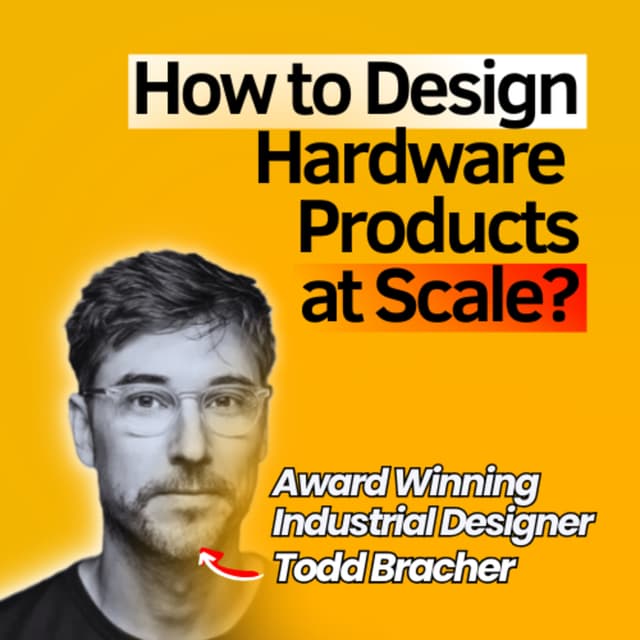
Transcript: Award-Winning Industrial Designer on How to Design Great Hardware Products at Scale? | Todd Bracher Founder of Betterlab | Startup Project #99
So the way I consider it so like sort of by definition, I hate to say that I know anything uh as a subject matter expert, but I am 25 years into design, but uh by definition in some ways, industrial d
2025-04-28
Listen to this episode
Award-Winning Industrial Designer on How to Design Great Hardware Products at Scale? | Todd Bracher Founder of Betterlab
So the way I consider it so like sort of by definition, I hate to say that I know anything uh as a subject matter expert, but I am 25 years into design, but uh by definition in some ways, industrial design is essentially um it's someone that really understands how to manufacture at scale. So you see a lot of kind of uh design objects, but it doesn't mean it's industrially designed. So it might be, you know, there's someone made five chairs in their garage and uh that's designed for sure. Uh maybe art version of crafts, things like this, but industrial design is things that's manufacturable repeat repeatable, manufacturable at scale. So, my expertise is that. and um so we understand very well manufacturing, materials, processes, uh the whole cap the whole orchestration around supply chain and uh engineering. but it's really A to Z and myself as a designer, I see myself as uh my responsibility is really to act as the representative of the market or the end user, the person actually using the thing. And at the same time the representative of the business who's manufacturing it, who owns it. So I'm really the kind of translator between the two. So the types of products that I might do could range from furniture to um beauty products. I do uh fragrance bottles for a brand called Isimiyake, a very well-known fashion brand. Uh we do glasses even uh it it can be a wide range of things even though a water machine, a water dispensing machine. So, it could be a whole host of things, which is kind of cool about industrial design. Hello everyone. My guest today is Todd Bracker. Uh Todd is the founder of Better Lab and industrial design firm that partners with scientists and innovators to create gamechanging products. He was previously executive creative director and design partner at human scale. He has also partnered with iconic brands like Isimiyake, Herman Miller, 3M. Uh he was twice honored as the International designer of the year and has been recognized by wallpaper magazine as top 100 global design influencer. Um in this conversation we'll talk about intersection of design, science, and technology, uh building a successful design firm uh and the importance for human centered design. Um if this is your first time listening to startup project, don't forget to subscribe to us. It will help us uh reach more audience. Todd, uh welcome to the show. Thank you. It's a really pleasure to be here. Nice to meet you. Um so, this is sort of like a interesting episode for us. Um we didn't have a lot of designers, especially industrial designers on the podcast. We are usually talking about, you know, things very specific to your going companies, um talking about growth, uh designing technology products, but I think it would be interesting to give sort of a different perspective on bringing products to market uh that are from a more designcentric perspective and I thought it would be really exciting to talk about the whole design world. Uh so I think a good place to start would be um you know, if you can give a quick background about your entry into design or your career till now and why did you get into like industrial design as a career? Uh I think those levels set the audience. Yeah, so I'm not surprised by the way that designers aren't usually spoken with regards to business or startups because I think um designers aren't usually part of that process. strangely enough, which is well, my frustration, I guess you could say. So, uh what brought me into design was um it started actually applying to uh art school uh in the 1990s and in New York, I applied to Prat Institute and to get into the school, you had to do a sort of visual exam. Uh so I completed this drawing and the the drawing's topic was to design this current breathing device for some hypothetical future where we won't be able to survive out in the open because of pollution and another various situations. Um so I was drawing this thing and kind of thinking through it, how does it work? Okay, if you're wearing it all the time, it has to look I guess good has to be comfortable. It's for men, it's for women. They go to work in it, I I maybe go to parties in it. always suddenly start start really thinking through the design process. and I submit the drawing uh which they were they were to review the drawing and uh but I then asked, what is that? because it's not illustration, I created a solution. And uh they said, well that's called industrial design, but that's not what you're applying for. you're applying for the drawing department. Uh that's the moment I switched to industrial design. Were you always like uh good at drawing things uh from childhood? Uh like what are you all like what made you like gravitate towards design? Like like what was that self realization? Yeah, I had really kind of helpful moments but uh for sure drawing has always been a part of my life and it it's kind of the lowest uh barrier of entry to seeing like your design or your ideas, right? My brother and I when we were kids, um it was interesting because he um we used to build these uh little plane models, you know these like plastic kit models and things. Uh he always said he wanted to be uh a pilot and I was always in love with the form of the plane and like wow, it's very purpose built but beautiful this kind of. So we had two different point of views of the same subject matter and interestingly enough he became a pilot and and and myself a designer. So there's sort of two ways interestingly to look at the same thing very differently and have very different experiences and results. To crystallize that idea of like industrial design. Can you talk about a couple of examples of products that you or projects that you've worked on um and brought into the market. So the way I consider it so like sort of by definition, I hate to say that I know anything uh as a subject matter expert, but I am 25 years into design. but uh by definition in some ways, industrial design is essentially um it's someone that really understands how to manufacture at scale. So you see a lot of kind of uh design objects, but it doesn't mean it's industrially designed. So it might be, you know, there's someone made five chairs in their garage and uh that's designed for sure. Uh maybe art version of crafts, things like this, but industrial design is things that's manufacturable repeat repeatable, manufacture at scale. So, my expertise is that. and um so we understand very well manufacturing, materials, processes, uh the whole cap the whole orchestration around supply chain and uh engineering. it's really A to Z and myself as a designer. see myself as uh my responsibility is really to act as the representative of the market or the end user, the person actually using the thing. And at the same time the representative of the business who's manufacturing it, who owns it. So I'm really the kind of translator between the two. So the types of products that I might do could range from furniture to um beauty products. I do uh fragrance bottles for a brand called Isimiyake, a very well-known fashion brand. Uh we do glasses even uh it it it can be a wide range of things even though a water machine, a water dispensing machine. So, it could be a whole host of things, which is kind of cool about industrial design. Oh, I want to slightly shift into like your perspective on some of the technology products. What are the products that you really admire in the world of technology that have um, you know, sort of have that design uh element and you know, constructed in a way that you know, you as a designer admire the, you know, reasoning behind their choices. And I I want to caviet that with you shouldn't answer it with iPhone. Um or anything Apple. Uh um and I want to get an answer that is non Apple because I feel like all designers their go to answer is always Apple. Yeah. Yeah, and rightfully so, if you're honest with you, uh Apple is really incredible. I mean, there's so many designs. for me in particular, I'm really interested in you know, I I guess you could say what's interesting, most interesting to me is how when I see design in the world that is not, you know, just simply like made out of wood or something like super straightforward, it tends to be leveraging a certain aspect of science. And and I recall seeing things such as uh color blindness correction. Uh I used to see things such as I mean, one example, I guess is uh even a project that we worked on was um this gentleman had invented this uh it's called UVC light, a spectrum of UVC light uh device that actually distributes it. It was he developed it for the space station and for NASA. And um and I had seen him deploy it into architecture. I was part of the team that helped create that. And what it's so incredible to me is the ability to in other words, we weren't making like a lamp and I think that's sort of the difference I'm trying to point out here is design very often focuses on like creating a lamp and and I see it and say okay, it's nice or not or I have an opinion. But when I see science en wol into, we'll call it the lamp. and when I say science in this case, uh germicidal light. So UVC light is a particular spectrum of light that will actually deactivate pathogens or any type of bacterial um virals etc. uh that are on surface or in the air. and while while you the human is in the environment. So it's human safe. and uh so this gentleman was able to figure out how to not only understand the science of it but engineer and develop the light engine that actually deliver it into a device that we can afford to buy that we can then therefore the designer now can design the package around it and to deliver it to the market. So, um it's this type of solutions to me which are fascinating. I mean, he's uh I've seen various uh technologies around uh even cameras. I mean camera technology is just unbelievable how it can measure and and respond to what's in the environment. So I'm very interested in how the technology and the science like interface with human and that's really the designer's job on how to make that interface. So, in the world of industrial design, what are the sort of in trends versus out trends that you're noticing? Um or you know, something that an average person will know about. So, I think it's interesting to say that. I and this is where I might inject too much of an opinion because the trends I see in design tend to be unfortunate in my opinion. They're not going in the direction that I would like to see them going. So, they tend to be very cosmetic. Um but a trend, I guess you can say that a trend, I guess you could say that's actually quite important though is uh sustainability. And I think finally you you will see if you're not yet seeing it, uh designers are using less material. they're reaching to materials that are recyclable or have coming from recycle material, uh ocean bound plastic or uh they meaning there's a lot of material that we're we routing from the waterways that are bound for the ocean to basically sit there. Uh we're we have um various generous companies that are collecting this material and reprocessing it into material for designers. Uh so this is um a really really wonderful. I wouldn't say trend, but it is a trend. It's going in that direction, the industry and that is I'm very happy about. So on one hand we have this kind of incredibly responsible trend we'll call it that I don't think most people see is happening right now, but it's it's happening. And then the other hand we have the kind of the old trend of just making kind of consumer consumable products. and I think that that seems me sort of disappointing. So right now I think we're in this transition point as as an industry. What what's what's disappointing about the consumable products? I think they're done a little bit irresponsibly um and without considering of let's say circularity or um or sustainability, you know, a colleague in in actually in my in my office at one point, she said, you know, we sort of looked at a building, we live in New York City and there's uh I don't know, it's a 30 story building and who knows how many apartments are in it, 100 apartments we'll call it. And we we had this sort of comment, how many hammers are in this building? And we if there's 100 apartments, there's probably like 90 hammers in this building and we think why is would there be even 50. shouldn't there just be like two hammers in the building and if you need one, you call the, you know, one of the the people who has it that person has it at that time and you borrow it and you just keep sharing it and it's kind of communal mentality and I think there's uh that's ways I think you can solve some of these problems. but instead there's a lot of everyone kind of all consuming things that they don't I I just as funny as someone who creates products, I'm sort of anti consumer consumerism now. What's your take on because you've designed furniture and I've always been fascinated by you know, IKEA. Um it's it's it's very mass market, it's very attainable. Um when people talk about design and designers, there's always this aspect of like it's high end or you know, it's inaccessible. but then you're also but IKEA is sort of like a mix of both those both worlds, right? In some sense, they have certain replica models of very famous, you know, designers of furnitures or uh lamps and they bring that to mass market. It's sort of like in some sense like the Zara of the uh furniture world, right? What what's your take on IKEA's way of uh either design or doing business? So, it's funny because they copied one of my lamps, a very well-known lamp of mine. um and they did a terrible job at it actually. It's not a very well executed version. Having said that, I kind of had a friendly argument with uh another friend of mine around uh the drug industry, right? And uh you can get a prescription pill for a you know, 80 a pill or you can get the generic for like $1. and uh and I think that's fantastic. I think it's terrible to have the, you know, the industry. So it's good to have this idea of a generic and I see IKEA, I welcome that they copied my design. if if someone finds it enjoyable and they want to have it in their life um and they can't afford or have access to the the folks that sell mine, that's fine. So I have no problem with it. Um I think, you know, I don't know enough about their practices in terms of sustainability because their volume is so huge and there I imagine a lot of waste with it. Um because it's so accessible, I think people tend to buy things and sort throw them away quite rapidly and and I think um it is what it is. I know from experience some of their product doesn't transport very well. So after you live with your book bookshelf for one year, if you're moving to your location it's like impossible to move it. It it does not want to move. It'll it'll fall apart. So there's things like this I don't love. uh but I think as a business they do make I think pretty good design very accessible and um I think that's quite good because I don't think design needs to be or should it be expensive. That's for sure. So at the end of the day IKEA is I much rather see IKEA than many of these sort of high-end design brands that don't really serve uh serve our community or world very well. What are some of the brands in furniture or uh you know, fashion that you as a design admire? So, one brand in particular, it's um a Swiss brand called uh Vizo, v i t s o e and uh Vizo, they do shelving systems, for example. Uh very simple extruded aluminum rail uh that you basically screw on the wall and then you between the rails a simple folded metal shelf. So it's very simple. Uh of course the system has expanded over the years. Designed roughly in the 1950s I believe. Uh de Rams designed it. He's the founding father of uh uh some would say of actually of Apple's design DNA. Um he's the founding father of the kind of minimalist design, I guess you might call it. And what I love about these products is they look incredible 50 years later. when are we now? 60, 70 years later? Like they're amazing and they're uh function perfectly. Uh they last forever. Um beautiful and uh to me that's the type of that's what I strive for in the work we do. How can we create something that's just so it will stand the test of time in the true sense and that to me is what I look for. Is that a big aspect of well-designed products like to be sustainable for a really long time and that's what adds in cost for a lot of well-designed products? Yeah, I think I mean that's at least the way I like to live my life. Uh have a few things in my life that I really need and also like and then uh and they live on forever and not to have to replace them every uh every few years because uh that feels irresponsible in some ways. I mean, I go to these shows in Milan, for example, there's the famous uh furniture fair and it's every year in April and there's many of these shows around the world and you go into these huge buildings and in in first of all, it's a huge compound, it's like an airport. and then there's 25 buildings, multiple floors and then in each building there's dozens and dozens of stands and booths. and then on each stand and booth, there's just dozens of pieces of furniture. I mean it's just an enormous amount and every year this stuff is coming out and uh and you the idea of where does it all go at the end of life is is it's a big question and our industry doesn't doesn't handle that very well. So, you run Better Lab. Um and I think you've been running it for a while. Uh talk to me about the business of, you know, running a design firm. Um how does it work and how do you like collaborate with your customers um and what type of products are you building in Better Lab? Yeah, so I have two businesses. I have um one called Bracher, which is my um design consultancy, I guess you call it. So it's inbound, meaning I work with clients and then I have Better Lab, which is sort of my outbound. Uh that's kind of my venture platform in some ways. Uh and I started Better Lab because we've been serving clients for two decades and um and I thought it was time I started doing what I actually really want to do. And uh I appreciate client work. it's really interesting, but I don't own it essentially. so I don't get to make 100% of the decisions. I'm there to support the client. So now with Better Lab it's it's different. It's really like they can choose. So, the way that we work is uh on either business. it's uh we have sort of three ways of engaging and well one is we do what we call diagnosis. So every company we touch uh we first are engaged to help understand what it is you need. It's like going to the doctor. Um we find a lot of folks approach a design studio and say uh here's the design brief. Can you please make this. And uh it's almost like going to the doctor and saying, you know, I know what's wrong with me. I just need this prescription and or this treatment. And uh which we don't typically do. You go to the doctor and you get diagnosed and then you receive a treatment. and that's how we like to work. So we do a very short period of about understanding and provide you a recommendation uh for for uh treatment essentially and then you can do this next phase with us or not. And uh in our next phase is then the uh we call opportunity discovery. We really start to put together now how what are we trying to solve for? And is this align with your business goals. Does this does this align with the market needs? And we sit and really study it until we find alignment there and then we move into the execution phase, which is the design portion. I almost call it the easy part in some ways. if you've done the front end of it well, then the this this portion is actually quite easy and then the last portion is the uh is now the the rollout and and communicating it and marketing of it and helping helping the business. We support their marketing teams or we actually can be the marketing team to help actually stamp that up. So it becomes really this holistic approach. Uh what are some of the products that that came out of uh Better Lab? Yeah, so we currently have two products that um so over the years I've as I mentioned um or maybe I mentioned, I have quite in love with science and the idea of physics and optics and things like this have been very fascinating for me my entire life and I had built uh helped built a lighting business for 3M over the years um and through this process it was really sort of a realization for me that design and science fit beautifully well together. We were creating technologies together and like leveraging their science basically and then with my design it was just a perfect partnership. And um so Better Lab spun from this uh thinking. So I got to know more and more scientists over the years and one of the products, for example, was uh I had had a uh beer essentially with a scientist friend and I said, you know, tell me what some of your fears about the world. And uh and one of the fears he had was also it was called um myopia. And I thought, okay, what is myopia? And um and then why are you you fear this? And and he said, well myopia is uh human eye is not fully developed uh through childhood. but well, okay. why is this a fear and where does this come from? And he says, well, he turns out was one of the guys who was credited with inventing the LED. Uh the actual the commercialized LEDs, not the Japanese team that created the LED, but the scaled manufactured version. And and he said the problem is the new LEDs since the last 10 15 years are very value engineered. So they're just visible spectrum of light. They're they're ignoring the vast majority of the spectrum of light. Mainly to save energy to it's a very efficient thing to do, but it's um not great for the human eye. So we the human eye it thrives off of the rest of the light that we're not delivering. And um and he says, so now kids are spending more time indoor. They have screen time has replaced outdoor time. Uh there's more homework than ever. All the interior lighting has been replaced with LED. Uh so the kids are not being exposed to full spectrum of light and he says, and I guarantee you children will have myopia in their life as we go forward and that's now what we're seeing. the World Health Organization has identified myopia as the largest threat to eye health in the last 100 years. They had they're anticipating half of the world will be myopic by 2050 and 10% of these folks will be blind in their lifetime. And uh so it's a it's it's a major epidemic that's emerging. By the way, one of the fixes for myopia is to go outside. That's simple. get sunlight and uh a few minutes a day, 10, 15, 20 minutes a day and uh and you'll be good to go. It's a problem in the first world problem we'll call it. It's happening in America, it's happening in China, it's uh less of a problem in rural parts of the world because kids are not stuck indoors and they're not they're not sitting in front of an iPad for hours on ends. Uh all this to say, so we've developed a pair of glasses that uh what it's quite interesting about is in the frame of the glasses, we attached very simply a uh glow in the dark material basically. It's uh that when they child steps outside or if you put the glasses near an LED light source, it charges them passively. So there's no plugging them in and on electronics at all. And what happens is this glow in the dark material, it delivers the healthy spectrum of light to the eye and uh so passively. So the child could be reading, could be sitting. They could be on a screen, whatever it is and they're getting a healthy spectrum of light and and it also reverses, thankfully it reverses actually myopia unlike traditional treatments such as chemicals and these sort of hard these hard lenses kids have would have to wear, which just sort of slows down the the progress. This actually reverses it. So that's one example of something quite fun coming from Better Lab. Yeah, I was looking at the pictures of the glasses and they look really beautiful and uh you know, aesthetic. um and also like as in some sense a little bit kid friendly, I think. I don't know if that was a conscious choice. Yeah, I have two kids myself and uh as young kids uh not soon to be 11 and and uh and a nine-year-old and the idea was what's cool about these is they glow and the prototypes, I remember having my son try them and it was something he was proud of to like show like it was cool that he had these like glowing kind of frames. and I think there's some interesting things you just don't know until you try them out, right? And so this idea of prototyping and experimenting and so we let their friends try and like kids who were really keen then they were like, I would like a pair and it became like almost like those light up sneakers you see kind of around uh which so it's kind of fun to see what we didn't expect uh we didn't we didn't know what to expect with uh the adoption of these. Yeah, I think uh you're also working on another sustainability project um using light. Uh talk to me a little bit about that. Yeah, so back to the story of UVC light and um so we started in uh right around COVID. um So, 2019. Uh I was helping this gentleman mentioned earlier around putting UVC light in architecture. And uh so what that was doing was help this it would help mitigate the spread of COVID or any other any other virals or pathogens at that point. Uh basically it would sterilize the environment while people are still in it. Uh so the the idea was it would keep restaurants open, shops open, uh it would just keep everyone and transparently would be keeping the environment clean. Um however, I was looking at this problem and thinking number one, there'll be a vaccine coming. So number two, these are not inexpensive and you'd have to cover your entire architectural footprint with these. Uh number three, people didn't understand the technology. so they had to be educated. So there's a lot of layers here as good as it sounded it it didn't seem to stick as a business. And um meanwhile, um I had my kids at that time were five and seven. I had taken them to some store and I remember we were putting uh you have to if you recall the gel sanitizer, the pumps that were always out and you'd pump and sort of on your hands and you kind of lather this uh chemical on your hands to kind of mitigate any concerns there. And I'm watching my two sons and I'm like, I don't know about this. I don't know what's in this chemical. I I don't know anything about it and every day all the time putting this stuff on their hands as kids. I don't know if that's a good idea. So on one hand I had this like problem of my kids like putting this chemical on their hands and on the other side I had a technology, uses light which actually stops the pathogens. So I just sat there and said, wait a second. what if we sort of merge the two? So, we quickly developed uh what we call whitewash. and whitewash is using this technology, UVC technology and uh in uh in hand device and and it works perfectly. You basically put your hands under and then within three to four seconds you have sterilized hands. and uh the the liquid sanitizer that you'd use does not get in the little folds and little corners and crevices of the hands. whereas the light does. it works absolutely perfectly. And we thought we were good there. We didn't go, we didn't think much more about it. Um but then I went further and I learned a few things. Number one, I read a report not that long ago that the gel sanitizers are responsible for 2% of the global carbon footprint. and so wow. how is this? When you think of the transport. so one of those jugs, you know, they're 10 gallons, very heavy or a few 5 gallons there. It's a lot of water. Their transport costs all the fuel and transportation involved with that, right? And then you have the storage problems, the maintenance issues, they're considered fire hazards. I had also done a um uh had a phone call with a woman who ran one of the national banks and she says it cost about $30,000 per bank for the liquid sanitizer just to keep it filled every year. And wow, like that's uh not realistic for a small shop to have like always this sanitizer available. So between the environmental concern, between the cost of it, uh our solution is uh displaces that completely. and we feel really incredibly happy that this uh emerged out of that. And and I think from a designer perspective, you don't know necessarily that that's going to be there. you're trying to make solve the problem and then you discover, oh wow, this is really a a needed solution specifically from an environmental perspective. You also uh are working with antler, you know, which is a widely known pre-seed stage firm and advising or partnering with their startups. Talk to me a little bit about that and like what sort of um projects or companies that you've worked on um at early stage. Yeah, so my role there was interesting because they don't make physical products. Most all of them. like most I feel like most of the uh, you know, Y combinator and all the the very few of them make like physical things. So and that's really my expertise. So my role with antler was more to ask kind of design sort of be be a design advisor essentially and ask the questions that maybe they hadn't considered from a design lens. Um but I wasn't valuable for them from a at a scale or rollout or things like this. This was not uh I wasn't needed. There was other advisors for that type of thing. So, my was more of to represent the sort of end users. So even things such as financial software, there was one around uh legal software as well and which is kind of interesting. Um where really my role would be to to say have you thought of that? Have they considered that? Do you understand like I don't feel this experience feels trustworthy when it's uh when you're dealing with like legal documentation. I think, you know, things like this, a kind of soft side of of their hard business. like what is it that really, you know, resonates with people? And that's that was really my role. Um are there any day-to-day products that you use because they are so good in terms of their design and like utility because I'm always curious when what do designers use that they like. Uh like probably something that I would have never thought about. No, I'm sure I'm I'm sure more will come to my mind but the first one maybe because where I am today at a photo studio but there's um Leica make these incredible cameras. they have since forever and uh they make what's called the M, the Leica M and it's I don't know exactly the year the first one but uh it's been might have been 1930, something like this. And that design is roughly unchanged today. It's evolved a little bit, but it's still very loyal to the original. And they use um it's all manual camera and there's no fancy anything on it. It doesn't shoot video, there's no autofocus. Um and what it does is it it provides a real be a real a connection with capturing an image. So it's the difference of like I don't know driving like an air cooled 1960s Porsche versus like today's like uh Honda Accord. You know, and the Honda Accord is a great car, it works perfectly, but it doesn't have the spirit of the essence of driving and like the feel of the machine and the road and catching to the road and all that stuff. And that's really what this Leica does. So it's quite interesting. It's like this inferior camera, but the experience is so superior that it makes you deliver your best work. What do you think about the modern design aesthetics? Because I I remember a couple of years back there was a meme where um on the left hand side there were sort of like all the brand visuals from maybe like three decades back, you know, Burberry, Vuitton and different brands and then on the right hand side their latest iconography and everyone sort of went through as a similar design pattern. Um what what's your take on that? Like is is that something that you observe in the modern design? What is the reason that is happening? Yeah, I think because I think the reason is uh one or two brands are kind of spearheading it and had success. and I think others sort of follow it quickly. So I do think that's a big part of it. I welcome it. There's I think design is late in this country. I do think Apple has helped unlock some of that with the iPhone. Um and rest of the world is very much I mean Japan and elsewhere in the world it's very very ahead of us US side of things and uh in terms of design. Um furniture, for example, we're we're light years behind here in the US than uh than elsewhere and uh take Scandinavia, for example, which to me is uh has set the standard that we don't don't understand here. Uh so all this to say I think globalization is is actually helping improve design here in the United States. So, while I think it's getting to your point, it can get a little sanitized or a little uh standard neutral if that could be a word. like it's become so kind of yeah, washed. uh but I do think at the end of the day I do think it's for the better at at the end of the day. I'm not sure I'm not the fact that everyone's the same that that I don't think's good. But I think it's becoming what happens when you create things that are simpler in that way, uh you're you have nowhere to hide. I think you're delivering things that are more uh more honest and um and I think that's kind of the contemporary culture we need right now. so uh rather than kind of hiding behind sort of flashy noise. That makes sense. I think it's also like on one sense you could see that and say everyone is following each other, but that is the other trend which is I think sort of a reversal from uh from a lot of flashy useless consumerism to a more minimalistic um use only what you need sense of consumerism. That's also behind that a little bit. and but I don't get that with luxury brands because the margins are so high, so you can do a lot of uniqueness in it, right? Um I get that with in the sense a lot of young people choosing and very being very specific and consuming, you know, less amount of things and uh only choosing each new item coming into their home or um, you know, apartment very carefully. Like I I like that sense of minimalism but then when you put that on the luxury side, it is sort of for a different reason, right? So it's sort of like opposite forces in some sense. Yeah. You know, to you're right and and one thing that's sort of interesting in at least in the home, that speak to the luxury brands, but you know, if you have um you know, you have your sofa, you have your table, you have your coffee cup, you have your television, like let's say you're creating your environment. Um you like to think they all speak to each other in a way, right? And uh visually and aesthetically. So, the fact that these brands are kind of adopting similar DNAs is is not a bad thing. I think now my you this another style of living, of course. and you might want a bit more eclectic and I think that also is valid. Uh but some of us that don't want that, I think it's nice to have things that actually start to make sense together. and it's rare when suddenly you're like, oh thank you. here's a a coffee machine that actually fits the DNA of the rest of my home. So, I think it's kind of why that similarity and there it is kind of in demand